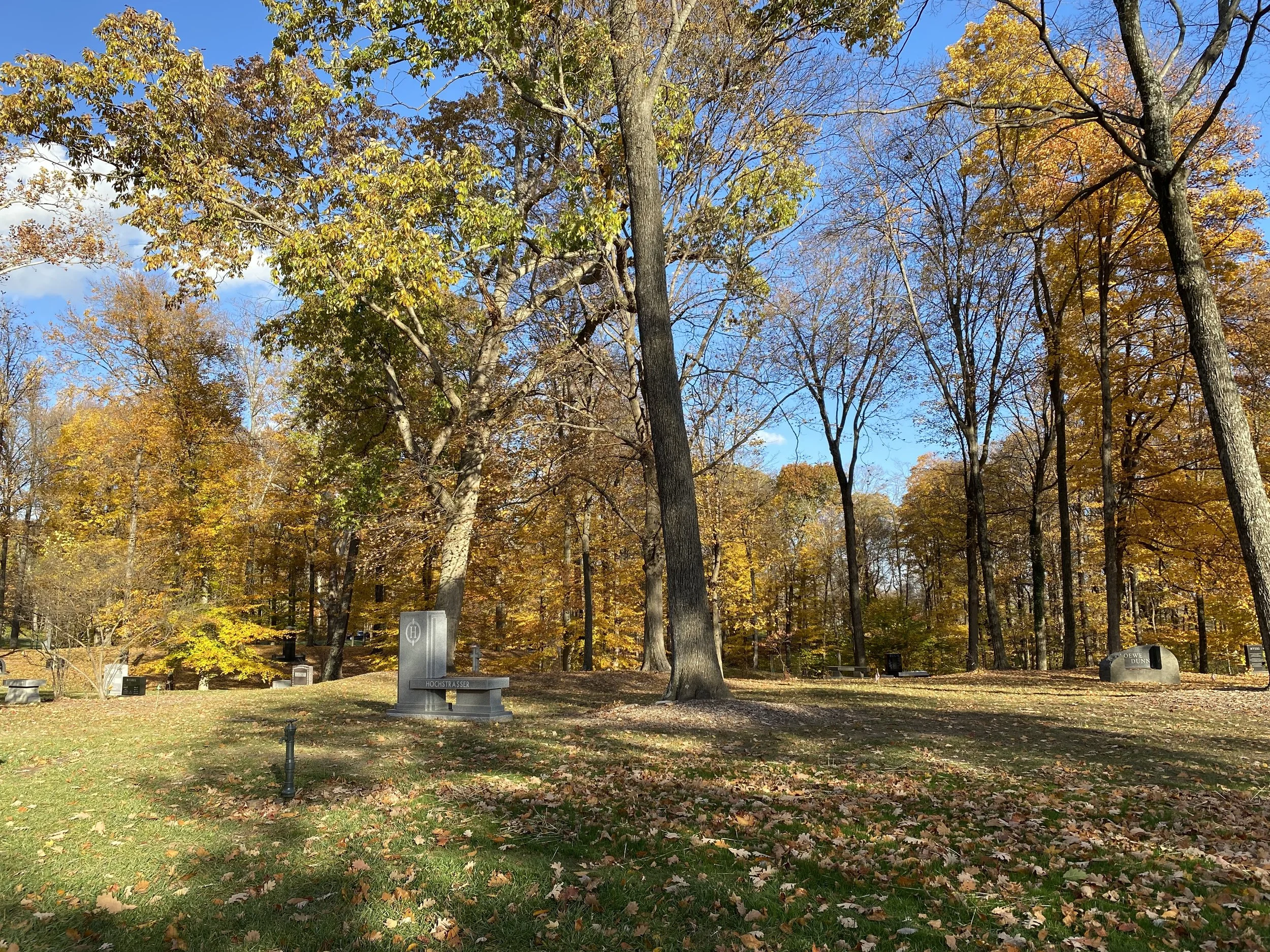
Spring Grove Cemetery in the Fall
The Footprint We Leave Behind
Blog 25 October 15, 2026
This week, I experienced something I had never before witnessed.
I was conducting a funeral service for a 55-year-old man named Brandon, who died several months after suffering a traumatic brain injury.
Brandon had spent his entire adult life as a commercial fisherman in Alaska. Think Deadliest Catch, the Discovery Channel's reality show about the boats and crews who haul in the delicious seafood we love to eat. Brandon appeared in the show's first season as a deckhand on The Lady Alaska after he had already been fishing up there for a number of years.
Between fishing jobs, Brandon traveled around the world. But he always made it back home to Cincinnati for a while—until the next fishing season would call him back to Alaska.
This was Brandon's life for more than 30 years. Along the way, he gathered friends the way some people gather seashells. Each one beautiful and unique, each one worth keeping. Brandon didn't want to let them go.
He gathered knowledge, too. He loved the natural world and was always eager to learn more about it. Spring Grove Cemetery was one of his most cherished places on earth. When he was home from Alaska, he spent hours walking, hiking, and exploring its hallowed grounds.
A naturalist at heart, Brandon felt at home wherever the great outdoors called him, from Spring Grove Cemetery to the Bering Sea and everywhere in between. His gift of gab, keen observations, diligent work ethic, and willingness to help others endeared him to people around the world.
His funeral service was standing-room-only. There were 147 people in chairs and at least 50 more standing along the walls.
After the service, a long procession of cars made its way to the gravesite, where Brandon's casket was laid beneath a 200-year-old oak tree. He had chosen the spot himself a few years earlier, never imagining how soon he would be laid to rest there.
I concluded my graveside remarks by recalling a saying his partner loved:
"Some people come into our lives and quickly go out. Others stay for a while and leave footprints on our hearts. And we are never ever the same."
Brandon left footprints.
But remember this: You also left footprints on Brandon's heart.
May you go in peace, remembering the love you shared.
Go forth now and share more love in Brandon's memory.
Then I stepped back from the grave.
The funeral director stepped forward and thanked everyone for coming and for allowing Spring Grove to serve them. She closed with an invitation: “Please feel free to touch the casket in a final gesture of love and take a flower from the arrangement as a remembrance.”
Then she stepped back.
And nobody moved.
A minute passed. Then two. Not a word was spoken.
A few more minutes went by. Finally, I stepped forward, pulled flowers from the arrangement, and handed them to Brandon's children, his first wife, his partner, and his sister.
Still, no one moved.
Then a brave soul broke away from his group and approached the casket, placing both hands upon it as he wept. Others followed. I handed out more flowers, watching the quiet reverence of family and friends still struggling to believe that Brandon was gone.
The mighty oak stood at attention, bearing witness to the love and appreciation people felt for this fisherman, outdoorsman, and lover of life and people.
Eventually, folks began speaking in low voices and moving around the gravesite. But they remained. More minutes passed. No one seemed ready to leave Brandon—or the community of admirers gathered around him.
A reception awaited them back at the funeral home, so eventually the funeral director and I began gently encouraging everyone to return to their cars.
As I write this, the reverence of those moments beneath the ancient oak fills me with appreciation for the goodness of humanity.
There was the goodness of Brandon himself, warts and all as none of us is without imperfections. And there was the goodness of the people who cared about him. They showed their respect in their attitudes, their attention, and even their attire. They had come not simply to attend a funeral, but to honor a man who had made a difference in their lives.
I came away with an even deeper appreciation for Spring Grove Cemetery, a remarkable place where history and nature exist side by side. Its towering trees, winding paths, lakes, and gardens make it feel less like a cemetery and more like a sanctuary.
And then there was Brandon's final gift to his family.
Brandon had made his own burial arrangements. On one of his adventures through Spring Grove, he had found the spot he loved beneath that oak tree and had chosen it for himself and his life partner.
He couldn't have known how soon his family would need those plans. He had taken care of the details so his family wouldn't have to make such decisions while also grieving his death.
We don't like to think about our own deaths. Yet making arrangements ahead of time is one way we can care for our families long after we're no longer able to do so ourselves. It is one less burden for the people we love to carry at a time when they have enough to bear.
Preparation is not pessimism. It is an act of love.
It's strange how death can bring about some of life's most beautiful moments.
If only Brandon could have been there to witness the love gathered beneath that ancient oak. Perhaps, in some way, he was.
He had chosen the spot where he would rest, but he couldn't have known just how many people would gather under that tree—or how reluctant they would be to leave.
We can't plan every circumstance surrounding our deaths. But we can make choices that help the people we love when the time comes. And then we can spend the time we have left leaving footprints on one another's hearts.
Gratefully, Donna
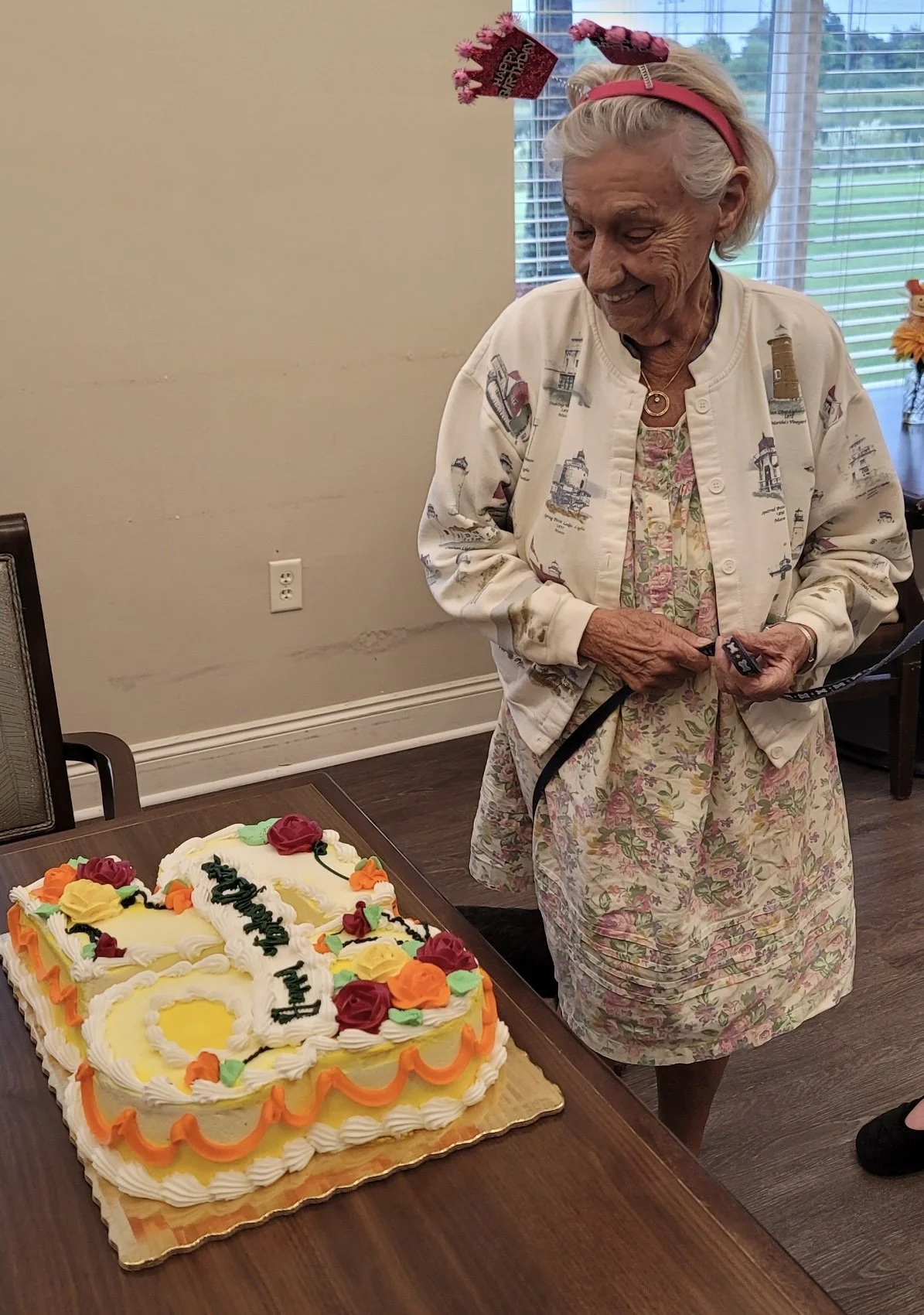
My mom on her 85th Birthday!
One Year Later: Still Pushing That Boulder
Blog 24 October 1, 2026
Today is my mom’s birthday. She would have been 90.
I told many of you about her a year ago, when she would have been 89. That was my first blog/email to my first faithful followers. Thank you to the original gang for staying with me and thank you to all the new gang for joining me.
A Year of Showing Up
October 1, 2025, was a big day for me. Gary, my husband, and I had labored for days trying to figure out all the website business after our son Josh put together a basic template. It was like pushing a boulder up a hill. We were exhausted when I finally hit publish.
It's gotten a little easier, but not much!
I've tweaked the site and published an article on the 1st and 15th of every month, missing only one posting in 12 months. I'm pretty proud of that.
Why I Keep Doing This
Because I learned in real time, as a caregiver to three different family members, what needs to get done during the “third act” of living. I know firsthand how much we don't know until we're suddenly faced with a crisis. And now I'm trying to faithfully and consistently share information about things we all need to be aware of and prepared for as we age, or as our family members and other loved ones age.
I do this because I wish I had known more before my mother began developing dementia. We faced many obstacles during our years of caring for Mom—obstacles that might have been much easier to navigate if we had simply been better prepared and informed.
Some of you may remember that I mentioned a book in my very first blog. That memoir, Getting Home: Distance, Dementia, and a Deadly Pandemic, tells the story of my experience caring for Mom from 1,200 miles away. It's the longer version of why I do what I do here. I'm now actively exploring publishing avenues, something quite ready for a year ago. I hope someday to share that story with a much wider audience.
I wrote the book for the same reason I started this blog: I want others to learn from what we went through.
Preparation doesn't prevent life's difficult moments. But it can make us better equipped to face them.
That's why I write, I speak, and I even chat people up in the checkout lanes at Kroger. I want things to be easier for others.
Spread the Word
I hope you'll consider sharing my emails with friends and family. A couple of five-minute reads each month could make a big difference for someone who hasn't yet considered some of these important issues.
I also speak to groups. Any group! A book club, a senior center, a Sunday School class. If you're in the Cincinnati or Fort Lauderdale area, I'd love to speak to a group you're involved with. Keep me in mind and check out my website for speaker information.
One year down. Still learning. Still writing. Still pushing that boulder.
And still believing that a little preparation can make a big difference.
Happy Birthday to my mom and Happy Anniversary to me!
And seriously, if you don’t have a Power of Attorney, GET ONE! You will be glad you did.
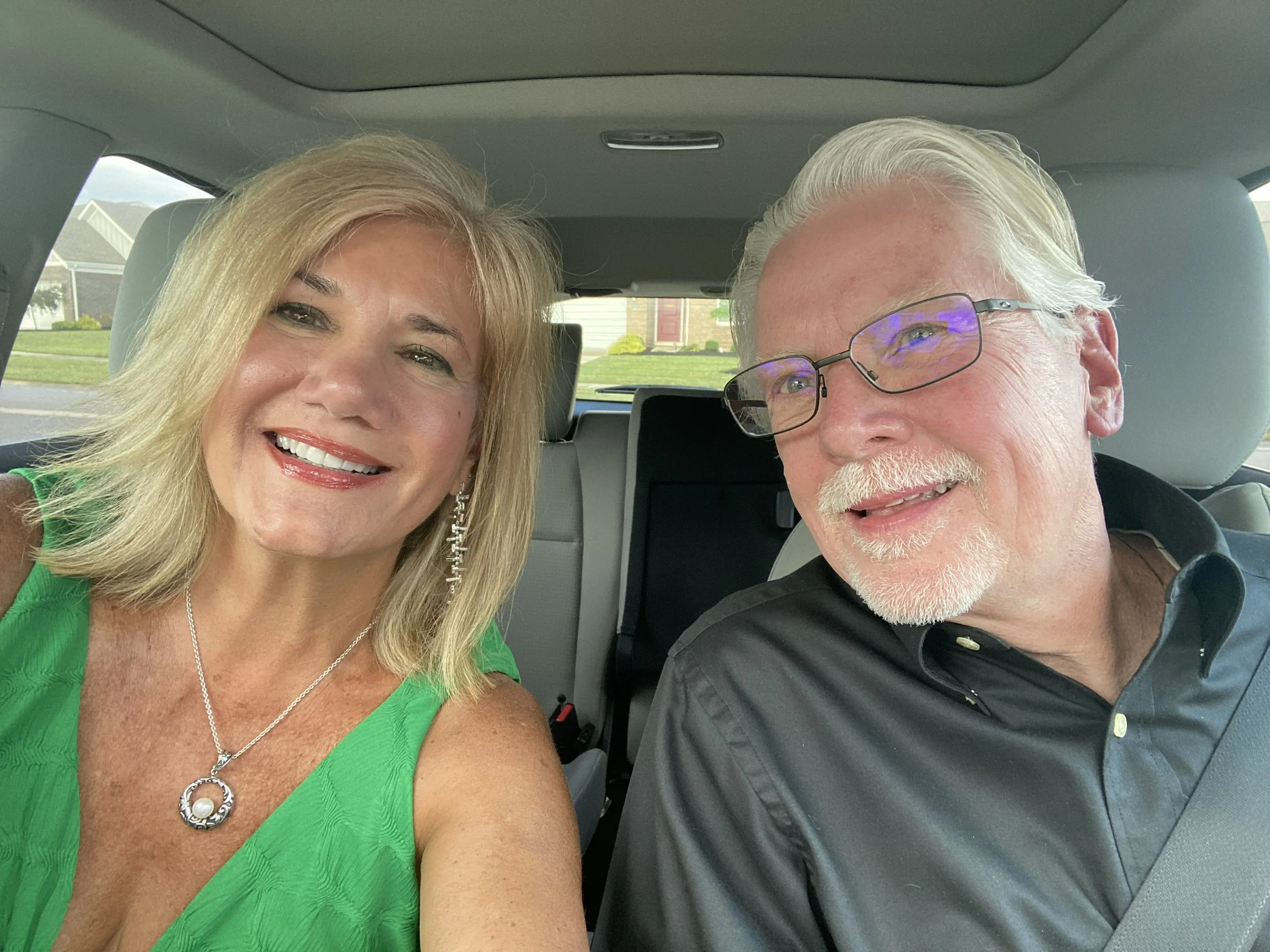
Gary and I head off to his 50th High School Class Reunion
LIFE COMES AT YOU FAST
Blog 23 September 15, 2026
I married an older man. That has to be understood before I go on—
Because I am about to tell you that we attended his 50th high school class reunion Saturday night. (I grabbed a selfie of us on the way!)
I wouldn’t want anyone confusing his 50th reunion with me being as old as he is. Vanity, thy name is still woman, as the verse goes.
But now that we are here: 68 and 63, we are not that old! I don’t feel it. Well, maybe a little in the plantar fasciitis in my foot or when I feel stiff in the morning. But in my head, I’m a much younger woman. Gary feels the same way.
And I think that trips us up. Not just us, of course, but lots of folks.
Sometimes when I tell people that I write about issues related to aging and elder care and invite them to join my email list to get my bi-monthly articles, they demur and say something like, “Oh, I’m past that. My parents are gone now. But thanks anyway.”
Wait.
Your parents are gone, yes. But aren’t you about 60 years old yourself?
What are you doing to be prepared for your own aging years?
I know you don’t feel it. But they are coming whether you feel like they are or not.
And are you ready?
Are you ready to possibly care for a spouse who has gotten sick?
Are you ready to continue managing your house now that you are traveling a lot?
Are you ready to have your children step in and lend a hand if something comes up suddenly?
Are you ready to climb up and down your stairs while recovering from a heart attack?
Are you ready to keep paying your bills when you are laid up with an unplanned illness?
Are you ready to know where your body will go when you die long before you had hoped?
I know, I know. That last one hit below the belt.
But it happens to people every day.
In my work as a funeral celebrant, I see it over and over again. This week, I am performing a service for a woman who, at only 67, was diagnosed with cancer after having some stomach pain. She died within two months.
Her death is a reminder of how little control we have over when life will change—and how much we can control about how prepared we are for those changes.
Did she have her affairs in order?
Would you?
Milestones like 50th high school class reunions are a blast, and they are needed. We need celebrations. Life should be as fun as we can make it.
Many parts of life are hard, so celebrating milestones and holidays and birthdays and graduations and retirements and weddings and births—and yes, even deaths—is critical to our overall enjoyment of life. But we can also use milestones to remind us of things we need to do along the way.
Every stage of life has us signing up for something, organizing another thing, documenting a new thing. Our older years are no different. But because we don’t want to acknowledge our aging and eventually passing away, we often put off anything that hints at that part of our lives.
My 87-and 89-year-old neighbors just had a couple of pieces of furniture picked up for repair. They want their children to have these pieces one day when they are gone—or perhaps when they further downsize into retirement style community if necessary. Moving to this new house was already one step toward their downsizing and preparation efforts.
So they sent the furniture off to be fixed so their kids don’t have to worry about that later.
Wow.
What a gift.
Now, I’m not saying every older person is responsible for fixing furniture they want their kids to have. But what I am saying is that my neighbors are thinking about their future. They know they will not always be here, and they are making arrangements that suit their lifestyle and personalities. They want to smooth the way for their kids.
What can you be doing to get a little bit ready for getting a little bit older?
Maybe you have already attended your 50th class reunion. Maybe it’s still twenty years away.
But regardless, life comes at you fast.
There are ways you can get ready for your future—or help your loved ones get ready for theirs.
I have ideas about that. Read my past blogs on my website. Or reach out directly anytime. I want to help.
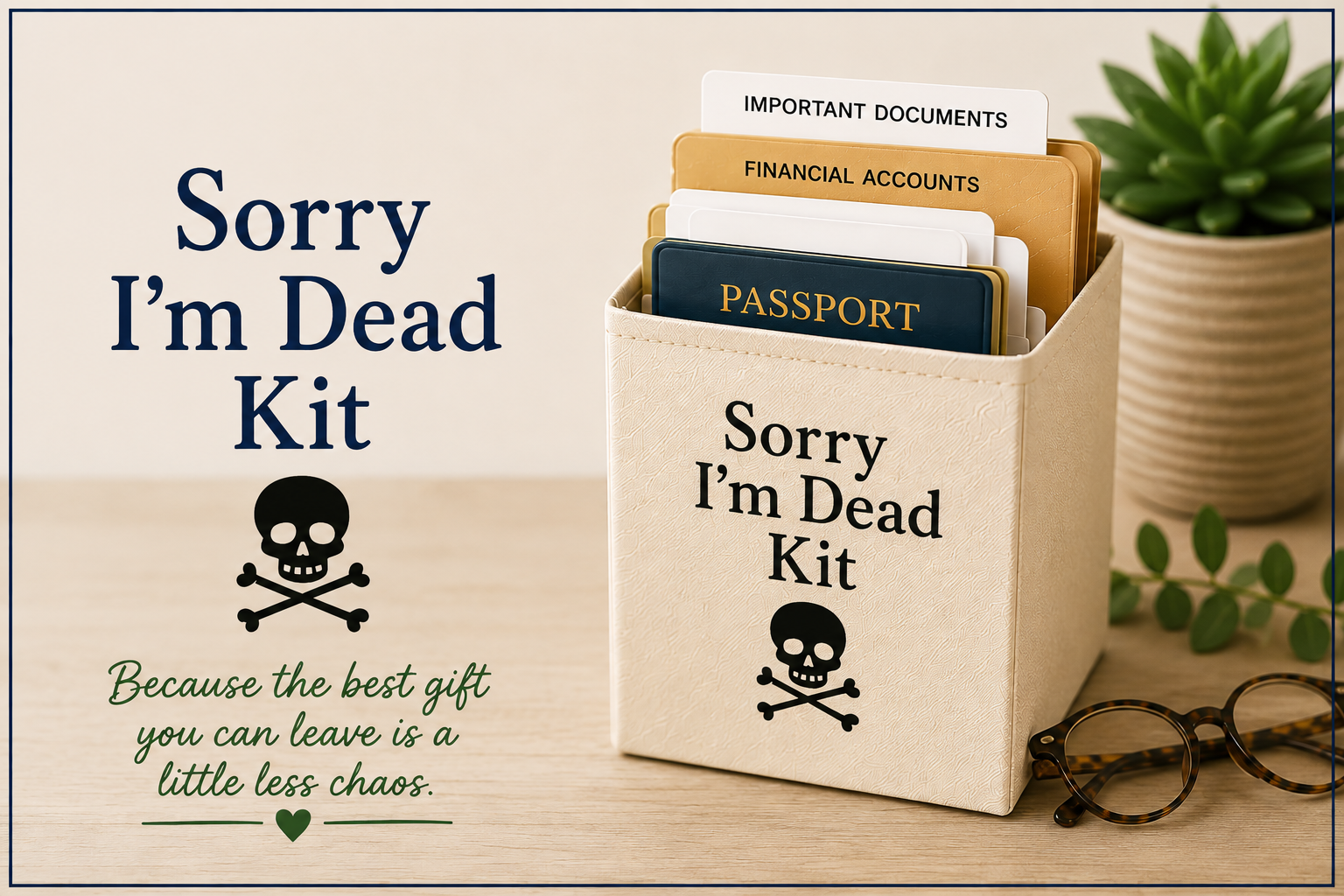
A real thing, but a fake AI generated graphic!
September is the Other New Year
Blog 22 September 1, 2026
January gets all the new year attention. But September has always felt like a new year start, too—even for those of us who haven't had a child in school for years.
September is a time to get organized and look at what's been sitting on the to-do list. Maybe this year, one of the things on that list should be: “Make it easier for my family when I die.”
At first, I wrote, “make it easier for my family if something happens to me” but let’s be honest here. It’s not an if. It’s a when. Something is going to happen to all of us. We are all going to die one day and we really should be ready for that. And there are a lot of things that we could have in place to make life after we are gone easier for our loved ones.
Recently, I came across the Sorry I'm Dead, Now What kit. It’s a real thing. And sure, it sounds morbid but it definitely caught my attention, which I’m sure was the intention of its creators. It is a provocative name for the moment in time none of us wants to think about.
The makers of this kit are basically saying, “Hey listen, I’m really sorry that I died, but I did and here are the things you are going to have to deal with now that I’m gone.” That would have been too long for a name so they kept it brief. Sorry I’m Dead, Now What says it all and then some.
Face it, most people are sorry they have to die and can also be sorry to leave their loved ones saddled with a bunch of responsibilities. If you fall into this category, then you can absolutely do something about it. Not the dying part, of course.
I mean, obviously, drive safely, look both ways when you cross the street, eat healthy food and don’t smoke—so you don’t die before you have to—you know that drill. Then on top of those precautions, you can get your affairs in order to make the time after your death easier for your loved ones. They are going to be sad enough that you have died. Don’t make it worse by leaving a mess.
You can buy a kit, or an online program of some kind or you can manage a “do-it-yourself” program by putting together the important stuff yourself.
And there is a lot of important stuff. But I would start here. Pick a location and tell your family where to find the "envelope.”
“In my top dresser drawer…”
“The left drawer of the office desk…”
“Next to the cookbooks…”
“On my computer, filed under…”
Then in the envelope something like this:
If you are reading this, something has happened to me. I’m sorry for what you are about to go through but for starters:
This is the funeral home I want you to use:
My funeral arrangement file is located:
These are the most important people to notify:
My will is located:
My other important documents are filed:
My insurance information is filed:
My attorney is: Phone #:
My financial advisor is: Phone #:
My password book is located:
The combination to my safe is:
I have pre-arranged for my dog/cat/goldfish to go to:
You get the idea. Each person’s list will be a little different. And the envelope, well, it’s just the starting point. The road map to all the other important documents.
I know, I know, it seems like a lot of work. But you don’t have to do it all in one day. You can take baby steps of information gathering. And you don’t have to be a senior citizen to do this. Anyone at any age can be prepared for the “just in case.” But if you are more than 65 I would say it’s time to stop thinking about it and do it.
It’s not morbid. It’s loving.
You can do a search online and find all kinds of preparation kits and systems and fireproof storage boxes, too! Here’s a link to the Sorry I’m Dead, Now What kit. I don’t know if it is the best. But it definitely has the best name. And no, I’m not making any money if you buy it, but I will be proud of you for getting started!
https://lawmother.mysamcart.com/sorryimdeadkit/
Remember to share this email with someone you think would like to be encouraged and informed about managing the older years well. Also, you can email me with your thoughts or experiences anytime. I always love hearing from you.
Gratefully, Donna
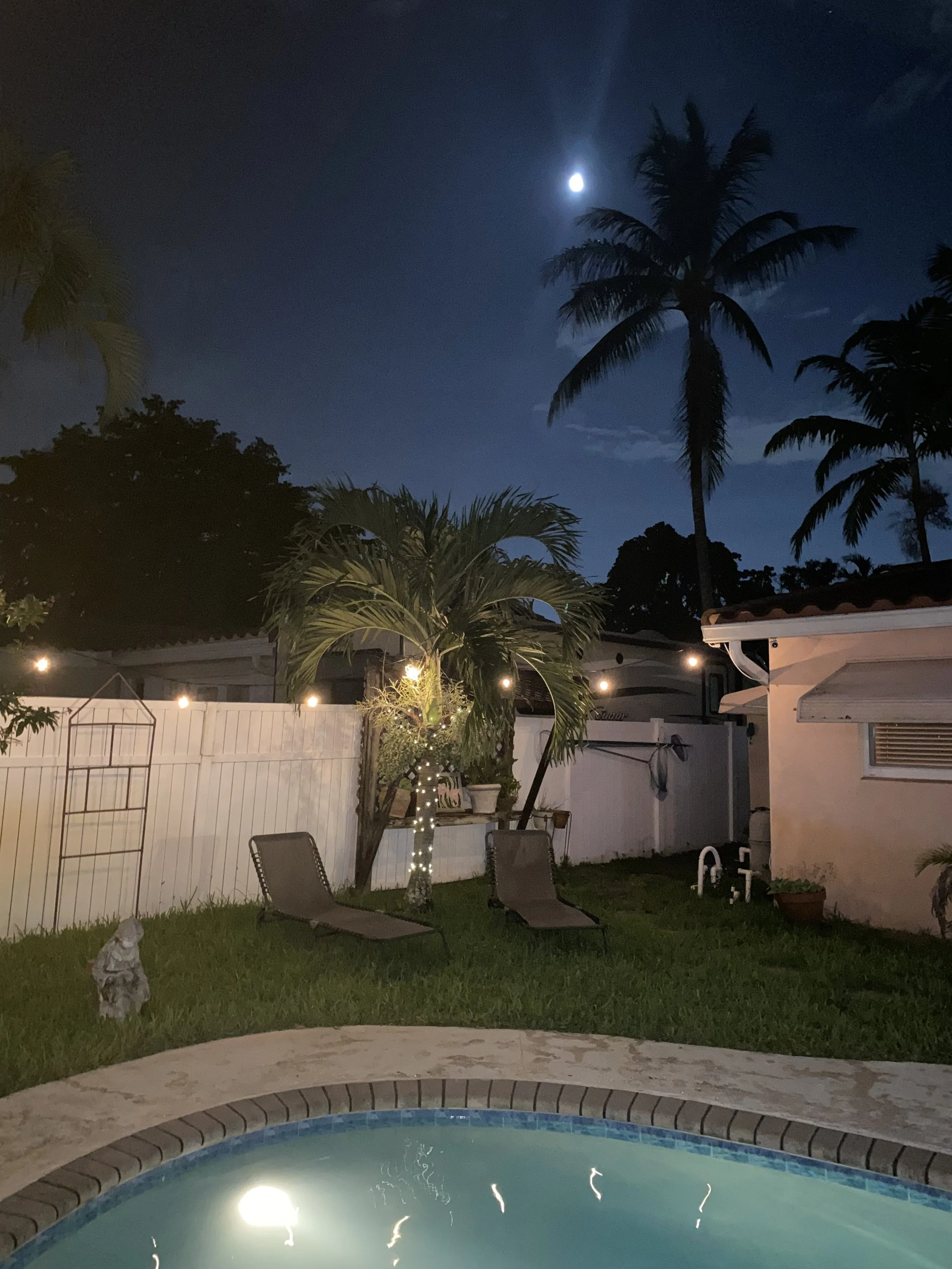
The backyard of my mom’s Florida house
The Great Decision Transfer is Coming
Blog 21 August 15, 2026
Last month, two years and three months after my mother died, I found myself back in her house in Florida.
We still own it.
All four of us. We inherited it as part of the “Great Wealth Transfer” that’s being talked about a lot lately.
The numbers are staggering. Estimates vary, but tens of trillions of dollars are expected to pass from older Americans to younger generations over the next couple of decades. One recent estimate puts the transfer at $36 trillion over the next 20 years.
And this year, the first Baby Boomers are turning 80. The population of Americans 80 and older is projected to double between 2025 and 2045.
Yes, a great transfer is coming. But it’s not just wealth. It’s decisions. And we are facing some of our own because our parents never made those decisions with us.
Our situation might be a bit unique in that my parents’ house was not our family home. It was the house we visited, the house where we brought our kids, the house that became part of our family history later in life.
Two of us want to keep it. Two of us are less sure or would probably prefer to sell. And yet, two years later, nothing has happened.
I’m not here to air our dirty laundry. We don’t have any. There is no villain in this story. There isn't even really a disagreement. There is just sentimentality. And history. And the difficult decision about what to do with a house that was my mother's house when my mother is no longer alive.
You can argue that it is a good problem to have. And yes, it is. I am grateful there was always enough money to properly care for Mom and a place for us to stay when we came to Florida to do it. BUT…
We had never made a plan for any of this.
Not before my mother's dementia became a thing.
Not during it.
And certainly not after she died.
And neither did she.
And I don't think we were alone in that.
While Mom was declining, there was always something more immediate to deal with. So we handled the next thing until there was no next thing. There was just the house. But the house is a lot. And it’s far away. From all of us. And it is as if the caregiving is still going on because we never made a plan for the house.
As millions of Baby Boomers age, families will be making decisions about where their parents live, how they will be cared for, what happens to their homes and how their assets will be divided. Some of those decisions will be financial. Some will be legal. Many will be deeply emotional and sentimental.
And the best time to make those decisions is NOT during the crisis of care. It’s before that. It’s before somebody has dementia, before somebody dies, before four siblings find themselves on Zoom calls trying to figure out what to do next.
I wish we'd understood that.
That’s what I would tell people now: Don't just make a will. Don't just decide who gets the money. Talk about the house. Talk about what happens if someone can't live there anymore. Talk about what everyone thinks should happen to it afterward. Talk about the things that matter to each person before you're standing in the middle of them, grieving and trying to make decisions at the same time.
Because the Great Wealth Transfer isn't simply going to move money from one generation to another. It is going to move houses, possessions, responsibilities and unfinished decisions. And like me, you will be dealing with all of that while facing your own myriad life problems.
It’s been seven years since we caught our mother getting lost in her car. She is gone. But we still have her house.
And we're still trying to figure out what to do about it.
Gratefully, Donna.
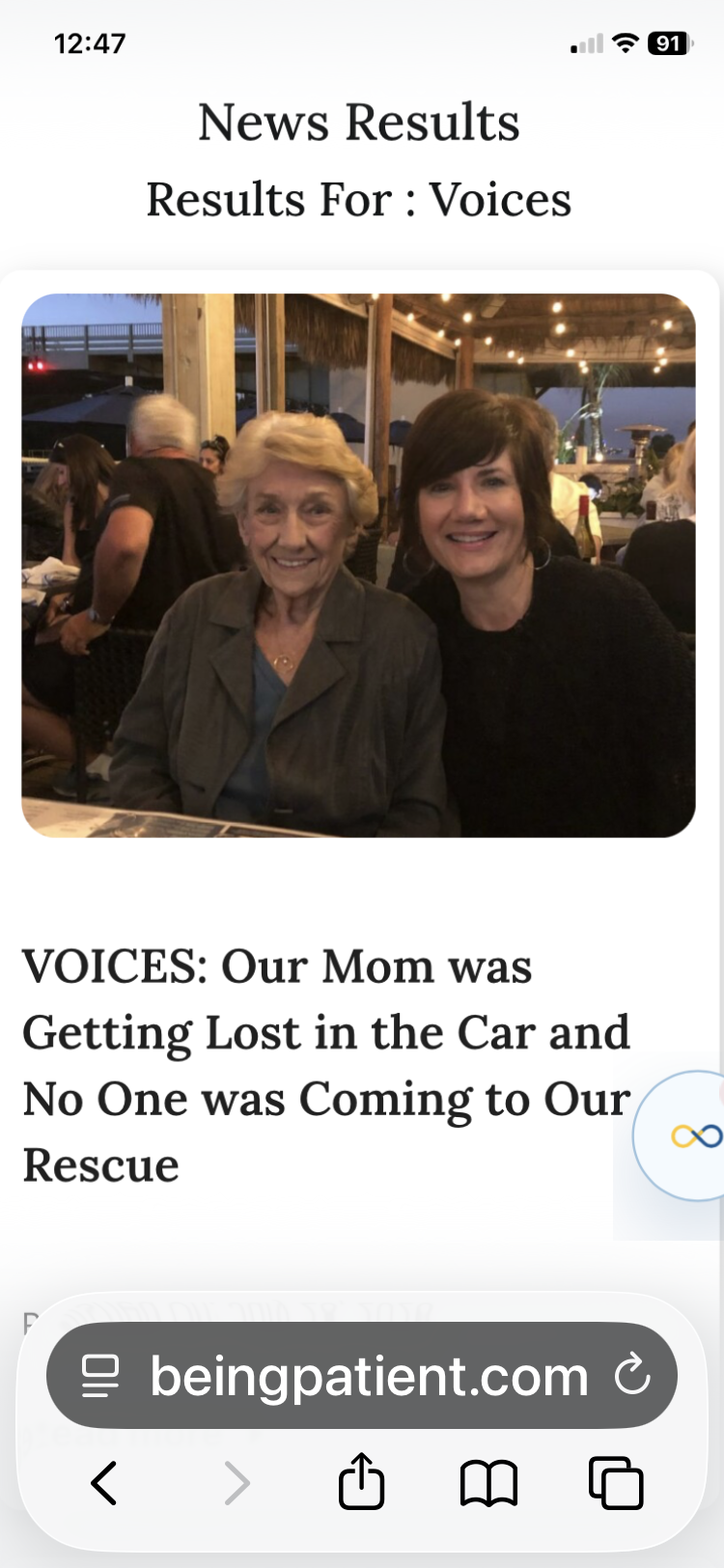
Screenshot from Being Patient Website
Sharing Beyond My Blog
Blog 20 August 1, 2026
Today I'm honored to share that Being Patient, a leading journalism-driven platform covering dementia, brain health, and caregiver issues, has published my essay, "Our Mom Was Getting Lost in the Car and No One Was Coming to Our Rescue."
If you've ever wrestled with when to take away the car keys, when to insist on a medical evaluation, or when to begin conversations about Power of Attorney, you know these decisions are more than practical: they are emotional, relational, and deeply personal.
Every family hopes someone else—a doctor, a friend, a professional—will step in and make the impossible decision for them.
Often, no one does.
That’s what happened in my family while we struggled to make the hard decisions without help. My essay for the Being Patient VOICES forum is my “truth serum” story—part confession, part cautionary tale. It doesn't flinch from what we did, where we failed, or how it felt.
I wrote this essay for the same reason I've written 20 blog posts, a memoir, and developed speaking presentations: to help even one future caregiver be better prepared for what lies ahead.
If my family's story helps even one adult child recognize the warning signs earlier or gives someone the courage to begin a difficult conversation, then sharing it is worth admitting where we got it wrong.
I'd be honored if you'd take a few minutes to read the essay in Being Patient. If it resonates with you, I hope you'll share it with others you know, or on your own social media platforms.
VOICES: Our Mom was Getting Lost in the Car and No One was Coming to Our Rescue | Being Patient
As always, I'd love to hear your thoughts. Have you ever faced a decision where protecting someone you loved also meant disappointing them?
Gratefully, Donna
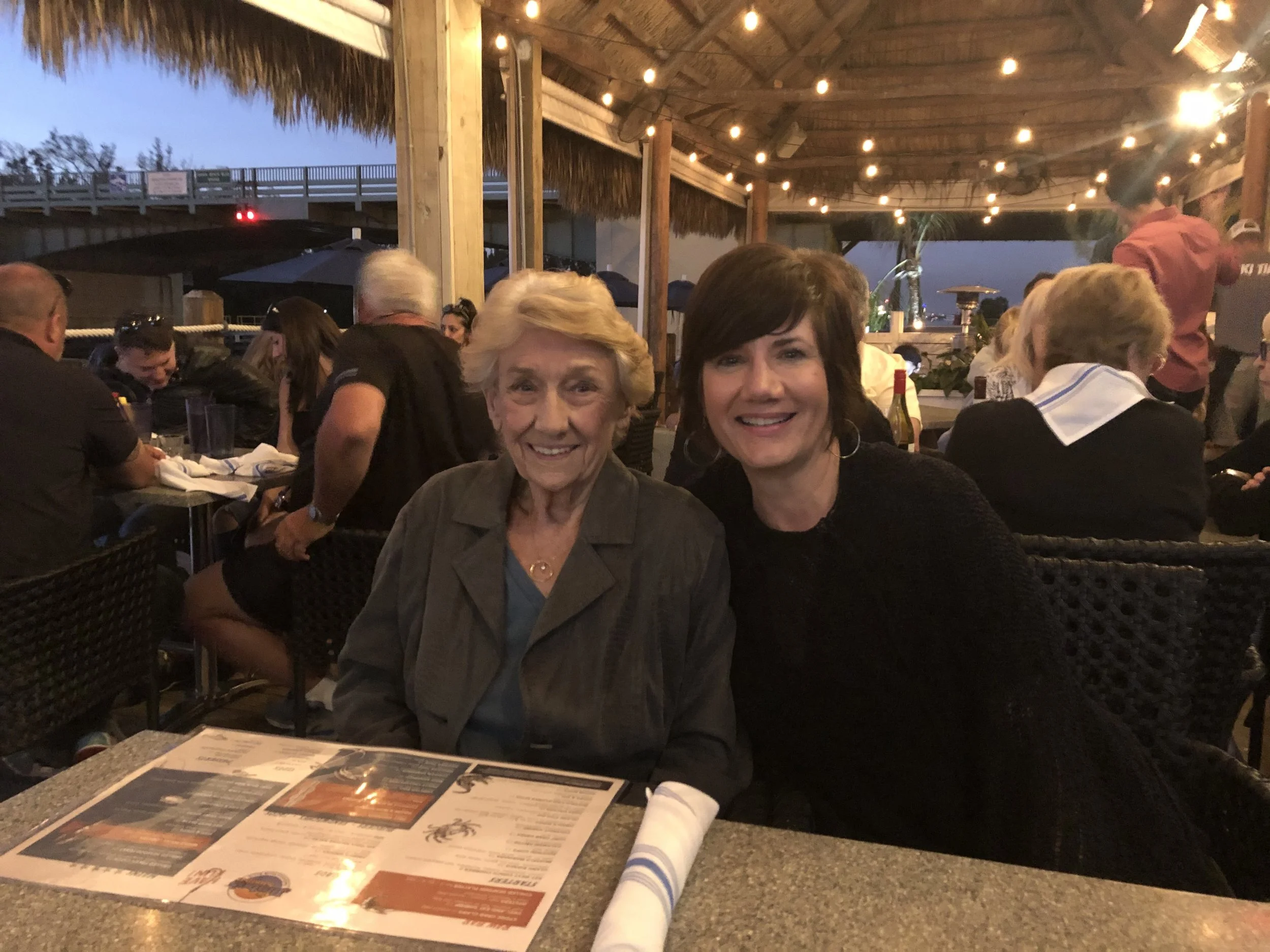
Me and my mom just as she was beginning to need assistance.
The Next Faithful Step
Blog 19 July 16, 2026
You are not obliged to complete the work, but neither are you free to desist from it.
—Rabbi Tarfon (70 CE–135 CE)
A new friend recently shared this ancient quote with me, and I just keep thinking about it.
The more I've reflected on Rabbi Tarfon's words, the more I've realized they speak to caregiving as much as they do to faith.
His words came to mind while I was catching up with my dear friend Ruth. She told me about her friend, Anne (name changed), who is beginning to show signs of forgetfulness.
Anne is a widow, and her only child lives on the West Coast—a long way from Ohio. I understood that situation all too well. My mother lived far away in Florida when she started declining and needing support.
Ruth is a helper by nature. She genuinely wants to support Anne, but she also wrestles with a question many helpers face: Where does my responsibility begin—and where does it end?
I found myself in the same place. While I may not be responsible for solving Ruth's dilemma, neither did I feel free to step away from the conversation.
"Ruth, would you be open to brainstorming together about ways to help Anne?" I asked.
"I don't mean to burden you with this," she said, "but yes, that would be great."
"Ruth," I said, "when I was caring for my mother in Florida, I learned a term I hadn't heard before unaccompanied adult. It's used there to describe an older adult aging without nearby family or legal support when help is needed. From what you've described, Anne maybe in a similar situation, even if Ohio doesn't use that terminology."
Ruth had already taken Anne to tour a few retirement communities and said she would gladly help Anne move when she selects a place. But as anyone who has walked this road knows, helping an aging loved one involves far more than moving furniture from one place to another.
I suggested two things.
First, perhaps it was time to call the local Council on Aging or Adult Protective Services simply to ask questions. Gathering information early could help Ruth better understand what resources might be available. Anne's memory issues, driving concerns, and a growing hoarding situation suggest that additional support might soon be needed.
Second, Ruth mentioned that Anne has nieces and nephews in Northern Kentucky. I encouraged her to reach out to them. They live close enough to step in and help.
Ruth cannot solve every challenge Anne faces. But she can explore meaningful ways to support her.
Sometimes the work we are called to is not ours to finish, even when we are called to begin it.
We cannot solve every problem. We cannot control every outcome.
But we can take the next faithful step.
We may never know how the story ends.
We cannot do everything.
But neither are we free to do nothing.
We must simply do the next logical thing.
What situation is calling to you?
How would you help an aging neighbor?
Oh, and about Anne. Since I wrote this, I learned that her daughter has now taken several steps in the right direction to help her mom. And like a good neighbor, Ruth remains ready to help if she is needed.
Gratefully yours, Donna
Donna’s Front Porch Decor
Independence Lost and Found
Blog 18 July 1, 2026
My mother lost her independence on Independence Day.
That was the day she got lost in her car for the final time—and the day we knew we had to take away her keys. This happened six years ago, and it remains one of my most distinct July 4th memories.
The other one feels especially vivid this year as we celebrate our country’s semi-quincentennial—our 250th birthday.
I was 13 years old, attending two weeks of Girl Scout camp during America’s Bicentennial celebration in 1976. Away from my family, on my own, entrusted with camp duties and fueled by youthful bravado, it was a glorious time of pride in our nation and pride in myself.
In the summer of ’76 how could I possibly imagine what that future Fourth of July would bring?
That July 4th, decades later, was marked by loss—loss of autonomy, loss of innocence, and a painful shift in the relationship between mother and daughter.
At thirteen, I felt freedom.
At fifty-seven, I felt burdened.
That July 4th in 2020, I realized I needed to keep my mother—and others—safe while also protecting something equally important: her dignity. That is the tension so many families face when caring for an aging parent. The argument may sound like it’s about the car, the house, or the checkbook. But often it’s about something much deeper: the fear of no longer being in charge of one’s own life.
Isn’t that what the colonists feared 250 years ago?
And that fear is universal: losing the right to decide for ourselves.
Some of those lessons remain the same.
—Pick your battles carefully.
—Know which ones you must win.
—Let the minor skirmishes go.
Even in their decline our loved ones remain whole persons until the very end and, with that, retain the right to life, liberty, and the pursuit of happiness.
During that carefree Bicentennial summer, I thought growing up meant needing my family less. Over time, life taught me a more complicated reality: we may need our families differently as life unfolds, but we never outgrow our need for one another.
Not in a family.
Nor in a nation.
Happy 250th birthday to these United States of America.
Gratefully yours, Donna
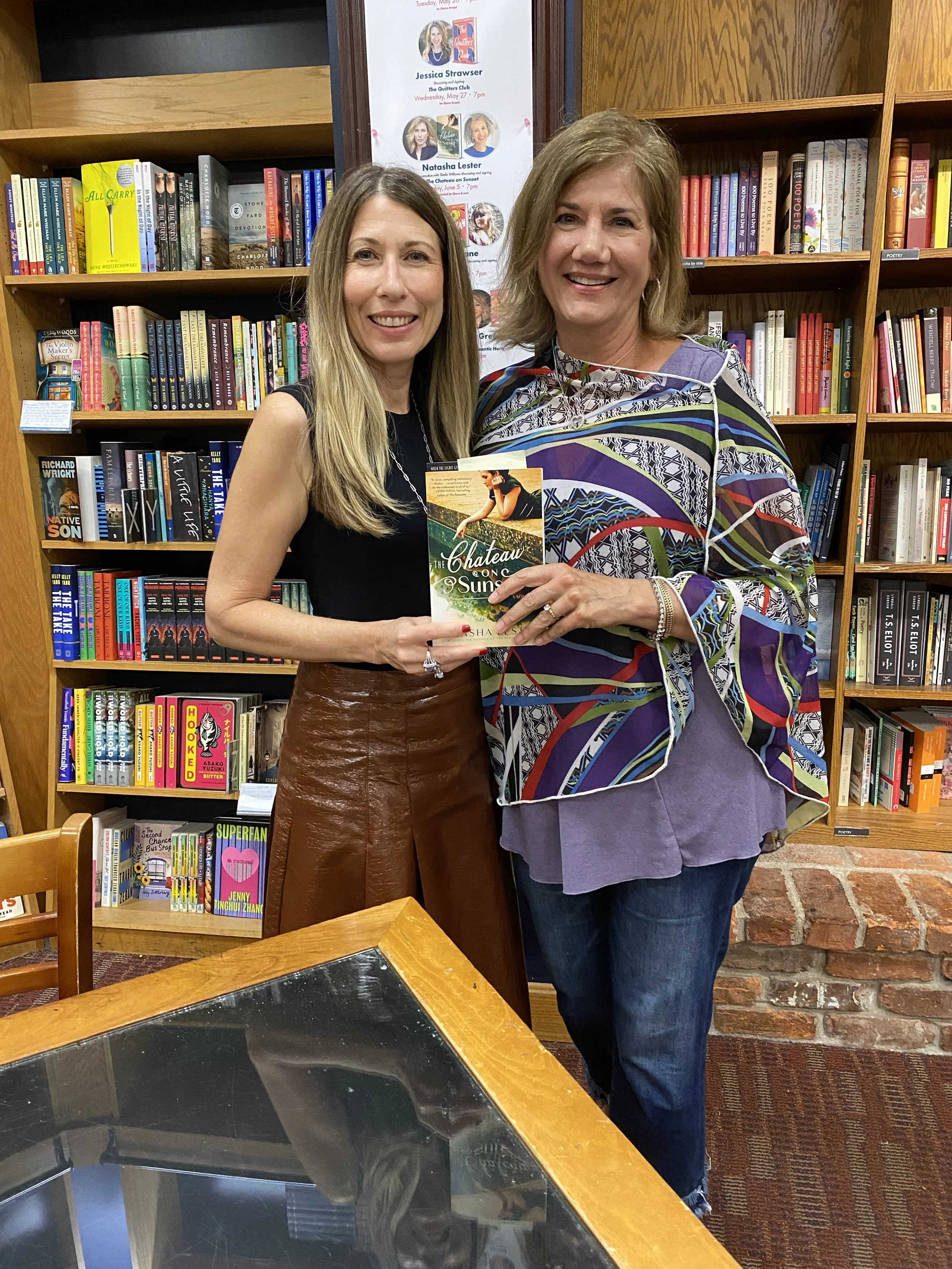
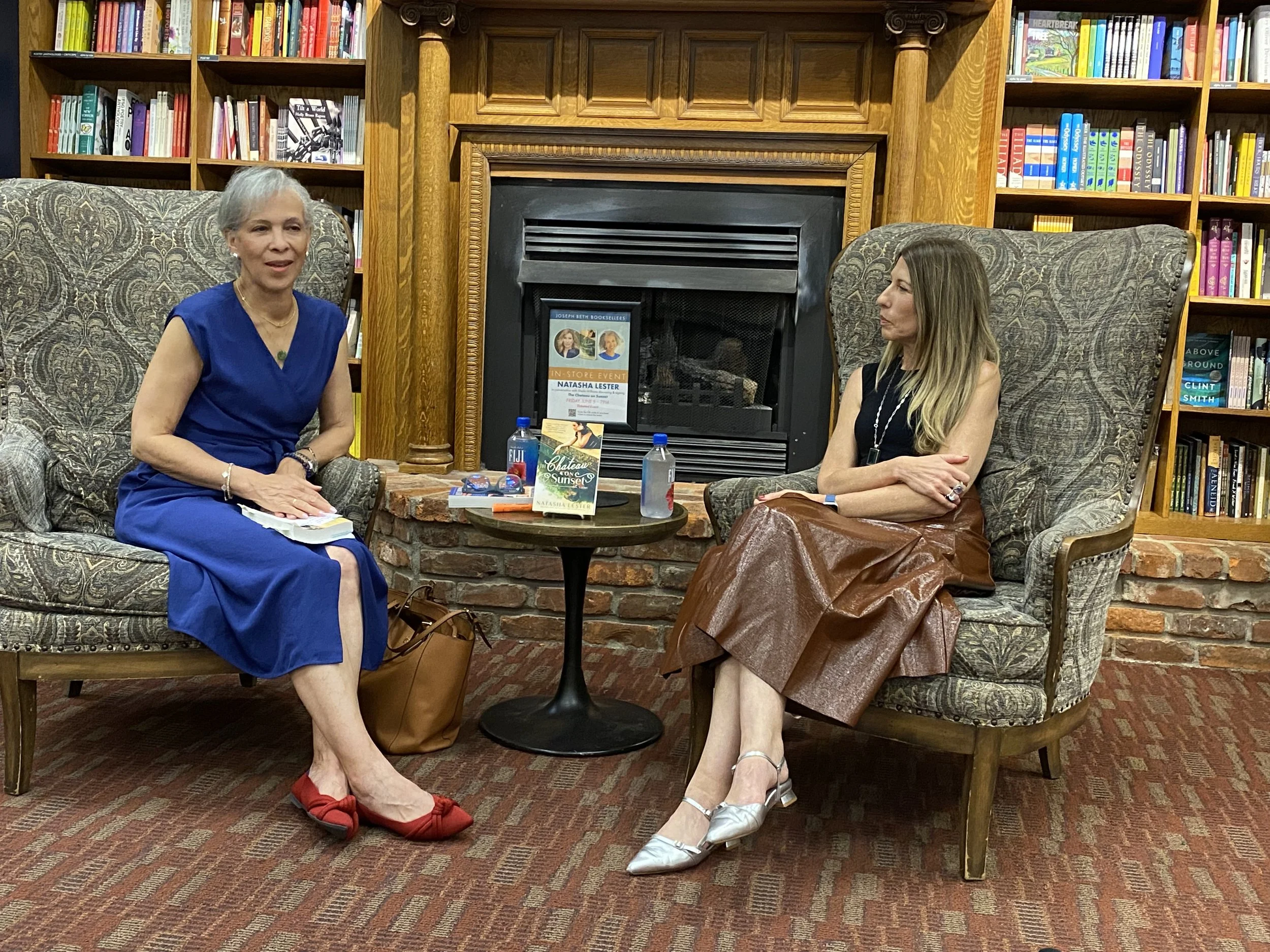
Donna Meeting Australia Author Natasha Lester
Local Author Sheila Williams Interviews Natasha
It’s Not As Late As You Think
Blog 17 June 15, 2026
This month, I met an author in a true small-world moment.
I study memoir writing with a teacher in Australia, which in itself feels like a small-world thing. Louisa Deasey teaches The Art of Memoir and how to pursue traditional publishing. We work together over email and Zoom. Recently, she told me about an Australian author she knows who writes historical fiction centered on strong female characters. Her name is Natasha Lester.
Natasha is currently on a three-week U.S. book tour, and last Friday she was in Cincinnati at our premier local bookseller, Joseph-Beth.
Although I had never read any of Natasha’s books, I felt compelled to go meet the Australian writer who knows the Australian writer I know.
And what fun that was.
I sat in on a conversation between Natasha and local novelist Sheila Williams (Dancing on the Edge of the Roof-adapted into a Netflix Film, “Junita”), a best-selling author in her own right. I even asked a few questions, from “How did you get from PR and marketing to writing novels?” (I, too, worked in PR and marketing!) to “How did you come up with the premise for your new book?” (It’s set in 1950s Hollywood with a Jane Eyre-inspired theme—and I do love some Charlotte Brontë.)
As I listened to these women talk about craft, career, and creative persistence, I realized this wasn’t just an author event. It felt like a lesson in what remains possible in the second half of life.
What does any of this have to do with Elder Journey Insights? Nothing—or everything.
Nothing in the sense that I’m not writing about Power of Attorney, downsizing, or preparing for our oldest years to come.
Everything in the sense that all four women in this story—Louisa, Natasha, Sheila, and me—are over 50. (Louisa and Natasha, just barely!) We are no longer at the beginning of our careers, fueled by youthful joie de vivre and a sprinkle of angst.
We are seasoned, focused, experienced, and still hungry to keep doing what we love—or, in my case, to begin again doing what I love after years of motherhood, daughterhood and detours.
We are evidence that there is always something more, and no reason to assume we can’t still reach for some of it.
Natasha built a successful fiction career in midlife and shows no signs of slowing down. Her three-week U.S. book tour suggests her dedication to her work is as timeless as her newest novel, The Chateau on Sunset.
What do you want to keep doing, get better at, or try for the first time?
It is not as late as you might think.
Sure, some things may be off-limits as we get older.
Maybe you’ll never be a Rockette dancing at Radio City Music Hall—but there are dance classes for every age. Maybe you’ll never be a Broadway actor—but community theaters produce Broadway shows all the time. Maybe travel abroad is no longer practical—but there are endless books to read and stories to watch that can transport you around the world.
Maybe I’ll never be a New York Times bestselling author like Natasha Lester, or a two-time memoirist and beloved teacher like Louisa Deasey, or have a book made into a movie like Sheila Williams.
But I can write this blog.
I can submit articles and essays to publications.
I can pitch my memoir manuscript to agents.
The ways we can still tickle our own fancies at any age are too numerous to count.
So let’s not bother counting.
Let’s just get busy tickling.
It’s almost never too late.
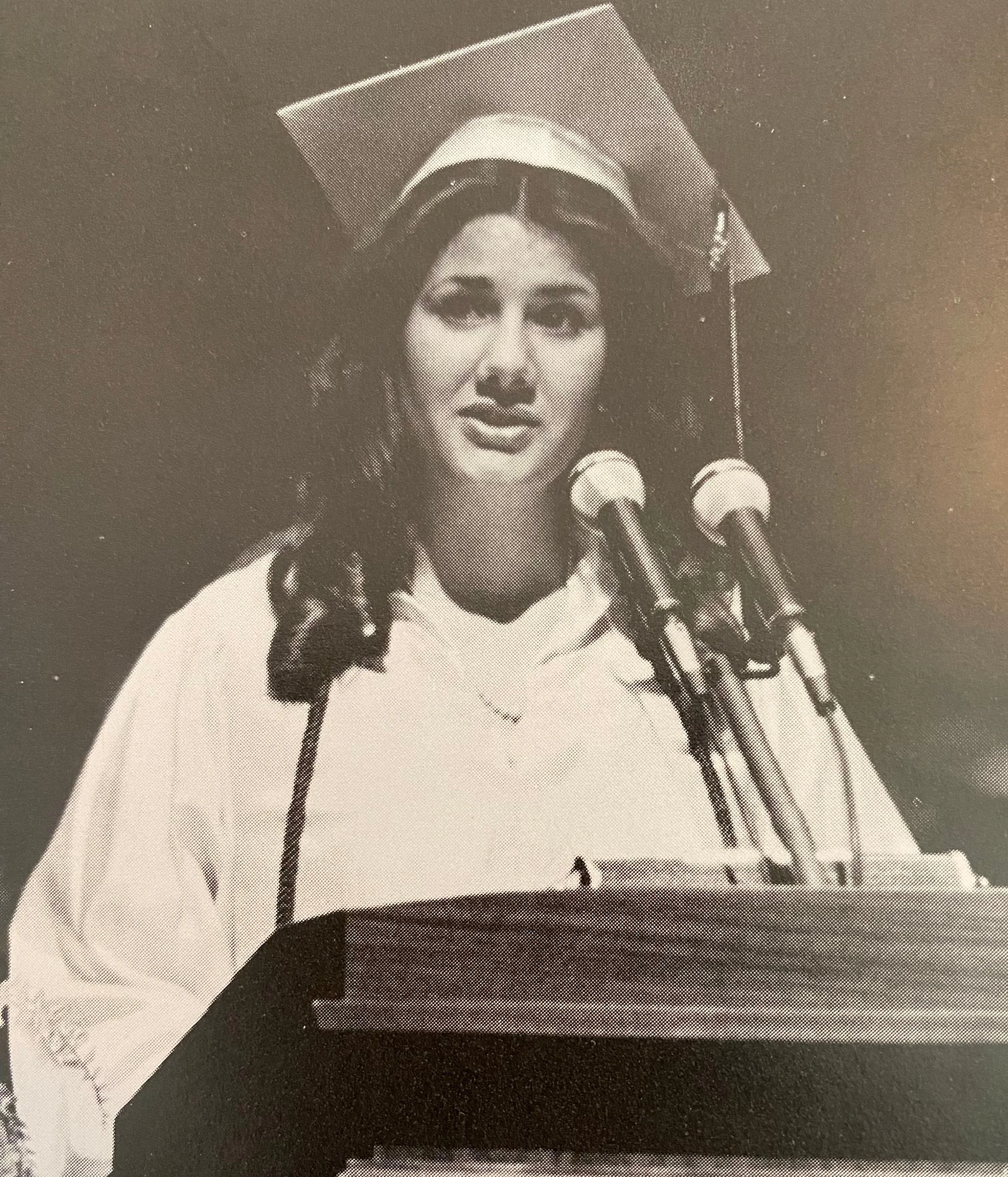
Donna Speaks at her high school graduation in 1981
A DREAM DECADES IN THE MAKING
BLOG 16, June 1, 2026
May 28th was the 45th anniversary of the day I graduated from high school. It was also the anniversary of the day I spoke to the largest crowd of my life after being selected to give one of the two commencement addresses for my high school graduation in 1981.
After high school, I studied broadcast journalism and worked in radio and television for a while. Even after leaving the news business, I kept finding audiences to speak to — clients at the advertising agencies in worked for, church groups, moms’ groups, and even campfire gatherings when my daughter was in Scouts.
For the last eight years, I have spoken regularly as a Life Tribute Celebrant, interviewing families, writing funeral and memorial services, and delivering them much like my journalism training prepared me to do.
Now I am developing talks related to elder care issues. Caring for my mother from a thousand miles away during a global pandemic taught me so much. I want to share what I learned — and what I am still learning.
But here’s the truth and how it relates to my blogging topic:
I’m 63. I am a senior citizen. Not exactly elderly, but definitely an elder. At this stage, most people are thinking about retirement. I can’t seem to do that. I have too much I still want to accomplish.
I spent 30 years focused on raising a family while this dream to share my lived experiences kept calling to me. The funeral work became an unexpected gift and continues to be. Yet something more still nudges at me.
No longer ashamed to admit it, I want to have an audience.
So despite my age, despite my lack of technical knowledge, despite a headache I have lived with for 27 years, despite ongoing challenges in my family life, and despite discovering that professional speaking is not for the faint of heart.
I keep showing up. And someday — soon, I hope — I will take the stage again. Older now. Hopefully wiser. Definitely more resilient.
If this isn’t an elder journey insight, I don’t know what is.
Gratefully, Donna
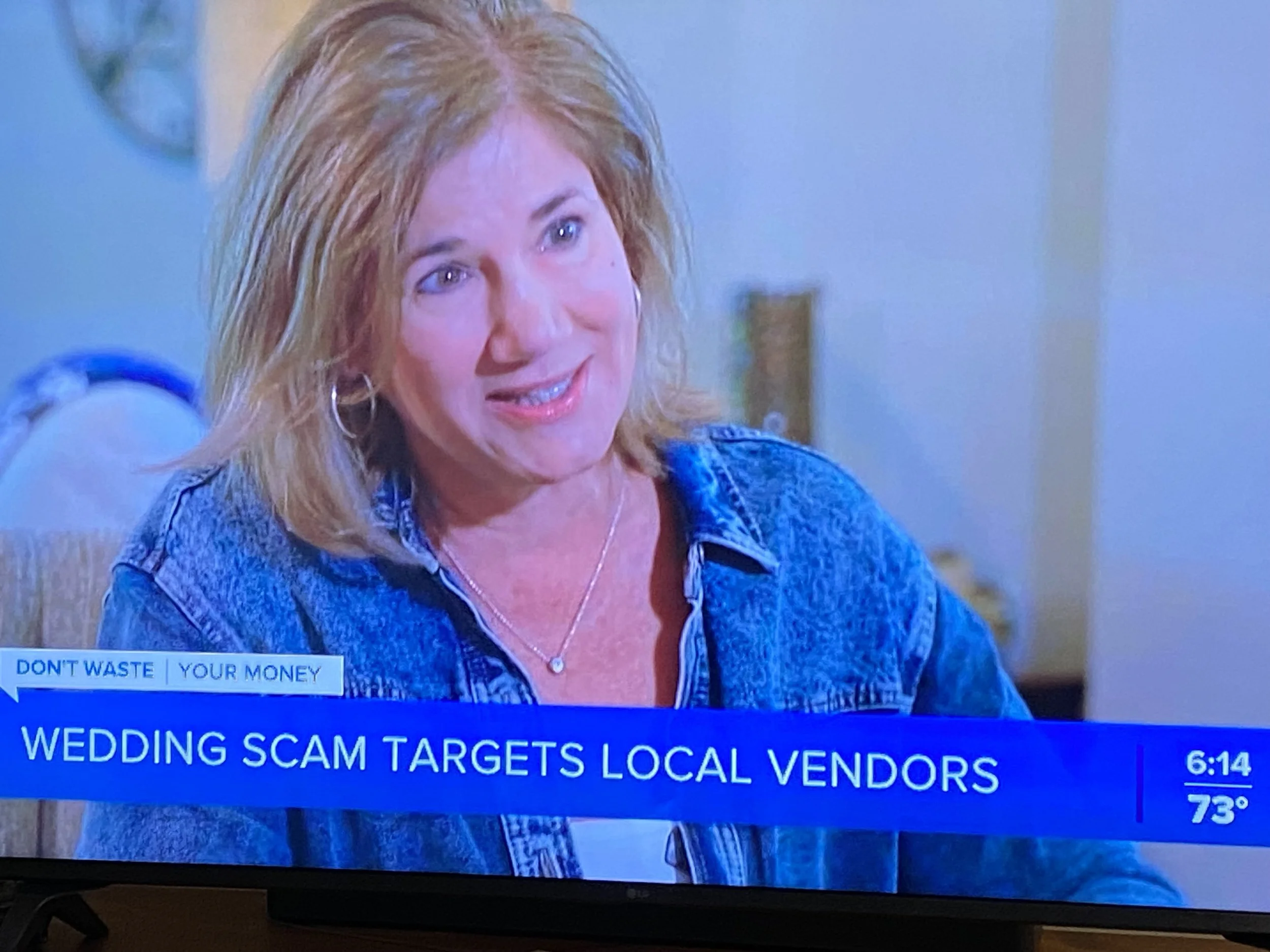
Scammers Came; I wasn’t fooled.
Blog 15 May 17, 2026
IF THE STORY FITS
A few weeks ago, our local Channel 9 investigative team aired a report about a scam that almost happened to me. I was featured in the story since I told them about the incident. When I told my husband I would be writing about the I-Team story for my blog, he asked what it had to do with senior or aging issues, since that’s my focus here.
Well, first of all, it happened to me — and whether I like it or not, I am technically a senior citizen. My birthday doesn’t lie, even if my brain still thinks I’m 42.
Second, it involved a scam, and scams targeting older adults are becoming increasingly common. In fact, I had just written about scams back on April 1. Who knew days later, on April 10, I would become a target myself.
It started with an email from someone who found me through a funeral celebrant website and asked whether I also officiated weddings. Coincidentally, I had recently become credentialed to solemnize marriages and was preparing to perform my very first wedding this summer. The possibility of booking another ceremony was exciting.
THE GROOM
I began exchanging emails with the “groom” to make arrangements.
That should have been my first red flag. Not because men can’t plan weddings—it’s just that historically, the planning falls to the bride. Still, I didn’t want to be judgmental or make assumptions.
Red flag number two was the awkward, stilted language in the emails. Again, I brushed it aside because his name suggested he might be an immigrant, and I didn’t want to confuse language differences with dishonesty.
Then came red flag number three. He was unusually eager to lock in the date and send a deposit before we had ever spoken on the phone or met in person. Despite my growing uneasiness, I “penciled” the wedding into my calendar and hoped for the best.
About a week later, the groom emailed again to explain that the check was on the way. However, there was one small complication: his generous employer, who was supposedly paying for both the celebrant and the photographer, had accidentally combined the payments into one check and mailed the entire amount to me. Red flag number four. What employer does that?
Once the check arrived, he explained, I could simply deposit it and send the overpayment back to him. Now I was really saying, “Hmmm.” Red flag number five.
I politely responded, “We’ll work something out when the check comes.” Then I told my husband. Within minutes he found “wedding celebrant scams” online—and there it was. Red flag number six.
THE SCAM
Here’s how the scam works:
The scammer sends a check for far more than the agreed amount. In my case, the celebrant fee deposit was supposed to be $250, but the check was for $2,250. The scammer then asks the unsuspecting recipient to return the “extra” money—usually through Zelle, Venmo, PayPal, or by mailing a check.
The victim deposits the original check, and at first the bank may appear to clear it. Believing the money is legitimate, the victim sends the overpayment back.
But days later, the original check bounces.
By then, the scammer has disappeared with the real money the victim sent.
Thankfully, this senior did NOT fall for it.
THE LESSON
Overpayment scams are incredibly common, and they can happen to anyone, for anything—not just older adults or for weddings. If someone sends you more money than you requested, stop immediately and question it.
Do not send money back. Do not “refund” the difference. And honestly? Don’t even deposit the check.
If the mistake is legitimate, the person can cancel the check and issue a new one for the correct amount. I asked my “groom” to do exactly that. Twice. Both times, he tried to pressure me into depositing the original check instead.
I finally told him the check had been destroyed and that if he truly wanted me to officiate his wedding, he could send a new check in the proper amount.
Oddly enough, I haven’t heard from him again. Which means it appears I’m available for a wedding on June 27 after all— just not his. Talk among your family and friends about these kinds of scams. Let’s stay aware together!
Gratefully, Donna
Donna reports The Wedding Scam to the I-Team
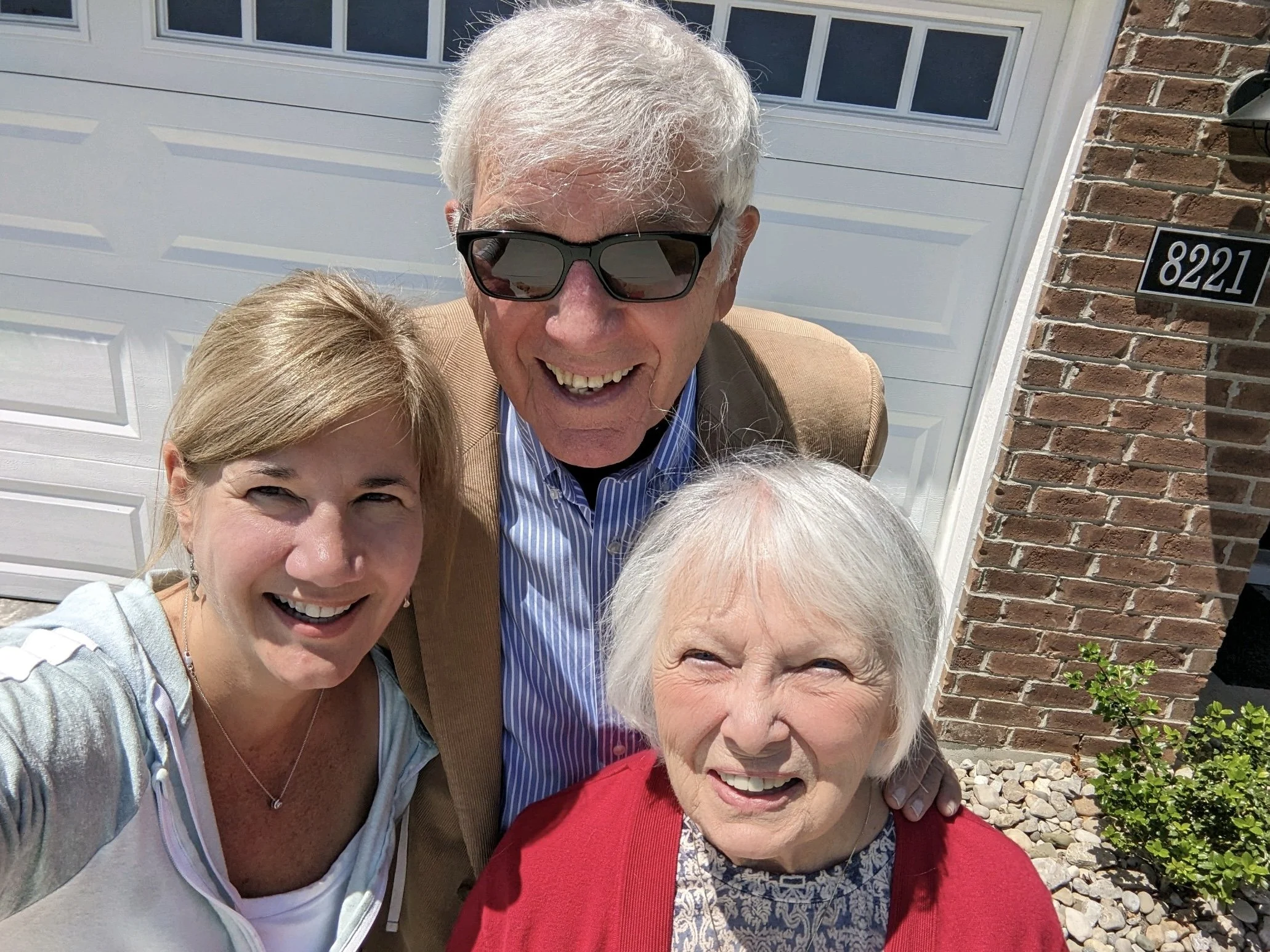
ABOVE: Me with Jim and Kay
BELOW: The improved pond view thanks to Jim
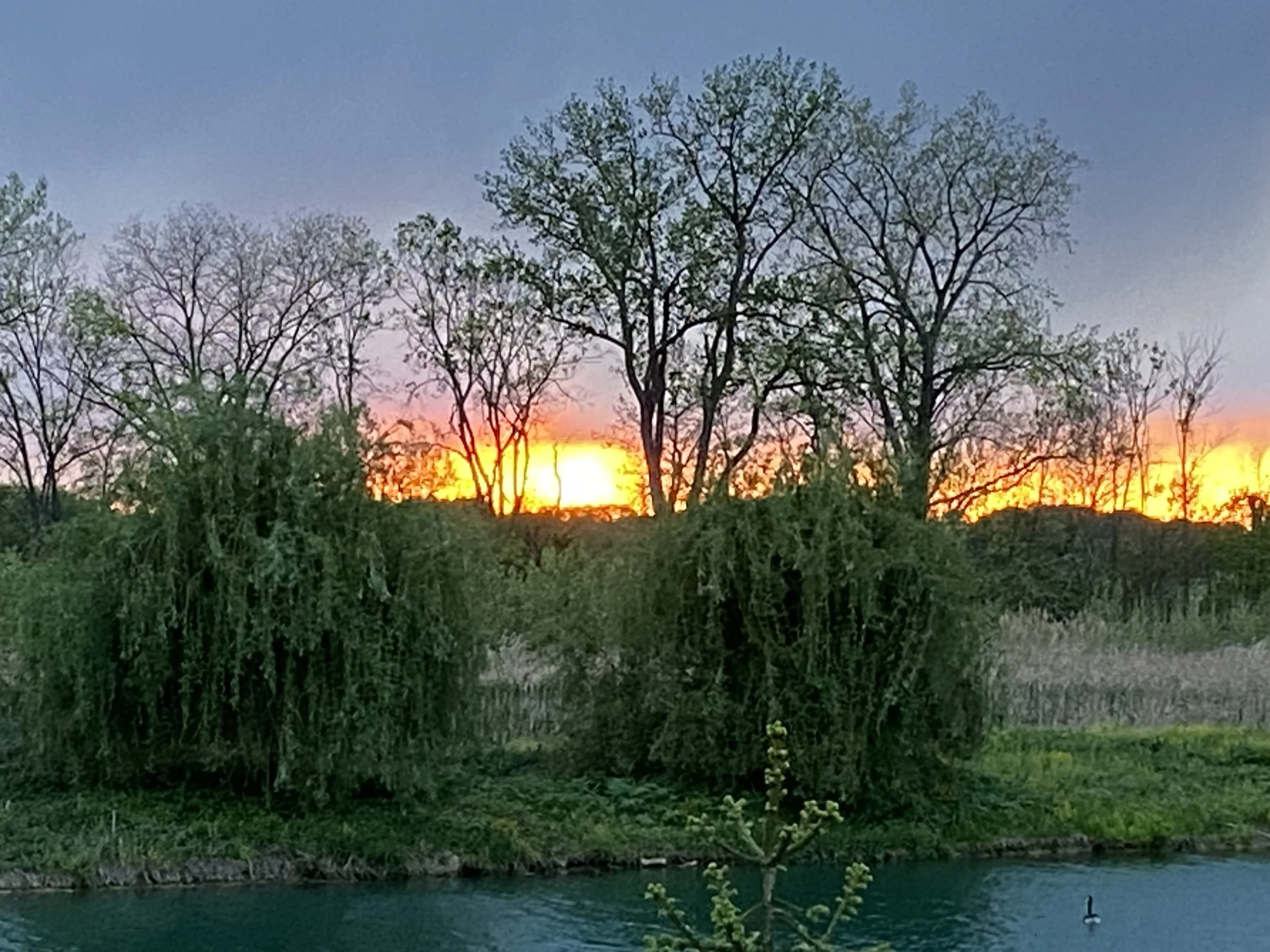
Lessons in Tree Trimming from my Neighbors
BLOG 14 May 1, 2026
MET JIM AND KAY
Jim and Kay are my next door neighbors. They are 88 and 87 years old.
They moved here three years ago from a small farm in Kentucky, trading acres of land for a one-story house on a pond. Their children—two of whom live nearby—helped them make the transition to what everyone agreed would be a simpler and easier life for them as they aged.
But “simpler” didn’t mean smaller.
Jim and Kay are fiercely independent and still remarkably active. Despite some challenges that come with age and perhaps from years of farming—and Jim’s years as an Air Force fighter pilot—neither Jim nor Kay have let health issues keep them from living life as they want to.
I admire that about them. I also have come to admire their children.
They don’t rush in to limit their parents’ lives. They don’t confuse age with incapacity. They don’t say “you can’t do that.” They understand that independence doesn’t disappear—it just sometimes requires a little support.
A LESSON IN ACTION
A few weeks ago, I watched that play out from my own backyard.
Jim had decided a willow tree across the pond needed to come down. It was crowding out two healthier willows and obstructing the view. Jim was determined to be the man for the job.
So his daughter Maureen came over.
She didn’t try to talk him out of it. She didn’t warn him about what could go wrong. She saw his determination and became a helper—not a naysayer.
She arrived in her blue vintage pickup truck, wearing overalls and boots. From our patio, I watched the two of them head off together, circling the pond with a chainsaw and Saturday morning ambition.
The chainsaw quickly felled the tree. And the view opened up.
Jim had been right.
On their way back, their pace slowed a bit. Another neighbor hurried around the bend in the pond and stepped in to carry the chainsaw. I felt a flicker of guilt that I hadn’t thought to help—but the truth is, Jim had me convinced he didn’t need it.
And maybe that’s part of the lesson.
Helping doesn’t always mean taking over. Sometimes it means walking alongside. Sometimes it means letting someone lead. And watching Maureen with her father, allowing him to lean into her as they walked, I saw something I won’t forget—not just care, but respect. A loving daughter honoring her dad’s autonomy.
REFLECTIONS ON AGE AND INDEPENDENCE
Ageism is easy to fall into. I have caught myself—more often than I’d like to admit—quietly deciding what someone should or shouldn’t be doing based on a number. I even wonder how often I did that to my own mom.
But now I catch myself.
Because of Jim. Because of Kay. Because of a daughter who understood that preserving her father’s independence and dignity mattered just as much as protecting his safety.
When I grow up I want to be just like Jim and Kay, and if I’m lucky, when I need it, someone will walk beside me like that—not to stop me, but to help me keep going.
Remember to share this email with someone you think would like to be encouraged and informed about managing the older years well. Also, you can email me with your thoughts or experiences anytime. I always love hearing from you.
Gratefully, Donna
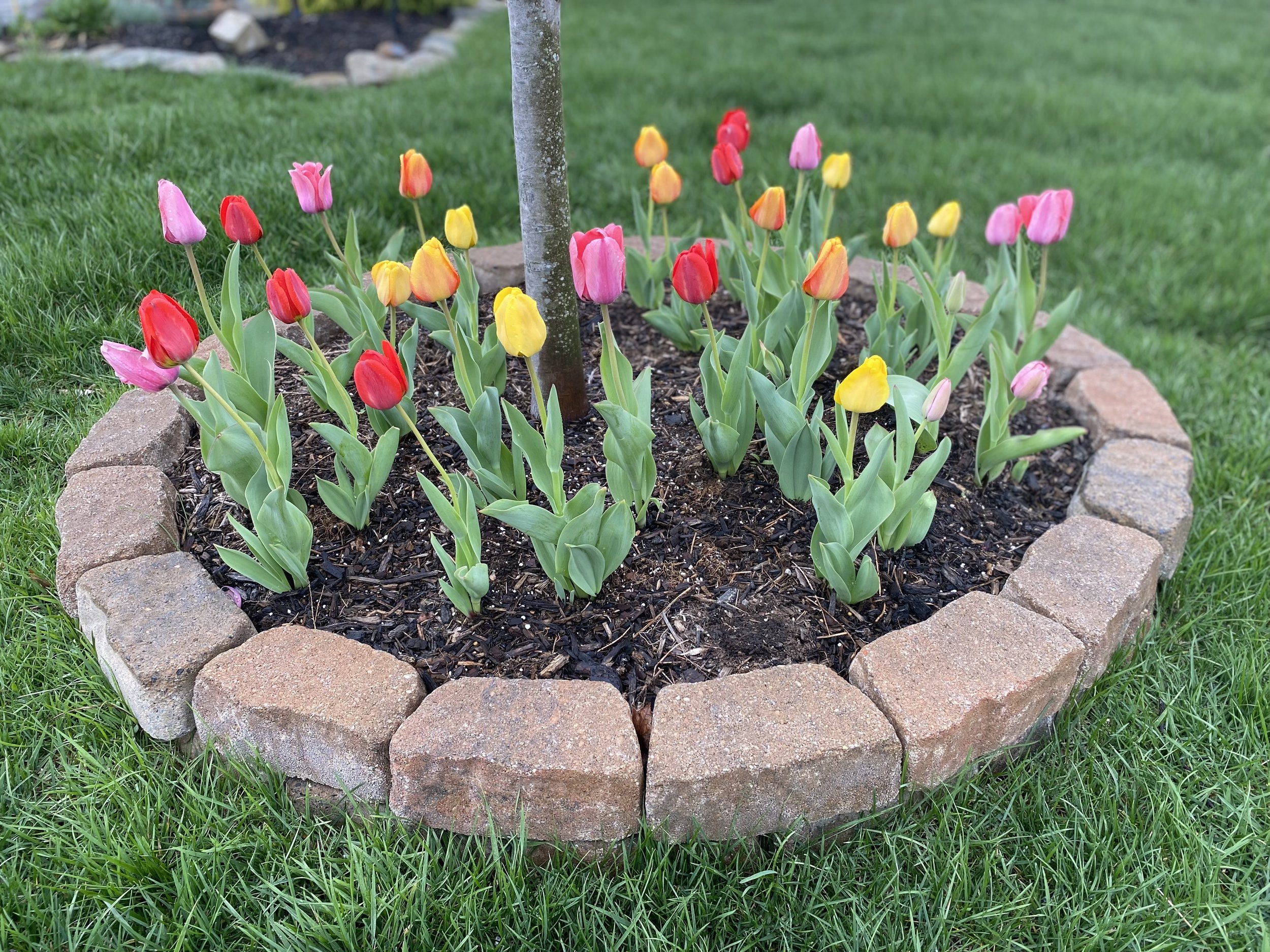
Tulips from Donna’s Garden
Don’t be Fooled by Scams in the Modern World
BLOG 13 April 1, 2026
The Super Power of Perfection
No foolin’—these TULIPS are REAL! Earlier today my husband was convinced they were fake, but it’s no April Fool’s joke. They are the genuine article, bright and beautiful, just as I hoped they would be when I planted the bulbs last fall.
Sometimes, reality can look so perfect that we doubt it’s true. Just as my husband doubted the authenticity of my tulips, it’s easy to question what’s real in today’s world of “deep fakes.” In a time filled with sophisticated scams and advanced technology, the line between genuine and fake feels blurrier than ever.
From Survival Instinct to Deception
Although humans have long had the capacity for collaboration and sharing, the instinct to survive could sometimes still lead to trickery. Whether it was a clever way to get more meat from a woolly mammoth or, nowadays, someone’s hard-earned savings, deception has always been part of the human story.
That old instinct still drives some people to cheat others out of their wealth—no matter how much or little. What used to be extra food is now someone’s nest egg, or even a thousand dollars in Target gift cards used to “help a grandson in trouble.”
Scams Hit Close to Home
This isn’t just made up—it happened in my own family about seven years ago. An older relative was told his grandson had been arrested. Even though the voice on the phone didn’t quite sound right, everything else seemed to add up, so he followed the instructions given to him.
He drove to Target, bought $1,000 in gift cards, and read the codes over the phone to the scammers who quickly drained the cards. My heart broke when I learned what had happened. This grandpa couldn’t afford to lose that money.
The New Voice of Deception
These days, scammers can even use snippets of someone’s real voice to mimic their loved ones in full AI (artificial intelligence) generated sentences, making it even harder for older adults to tell what’s real. Imagine a grandfather hearing what sounds exactly like his grandson pleading for help—it’s easy to get fooled.
Staying informed and up to date on trends is important. “FRAUD 2026: Your Guide to Spotting Scams” is headline article in the March/April 2026 issue of AARP Bulletin. This issues features new scams to watch out for; simple steps to stay safe; ways to fight back and several members who bravely tell their stories of being scammed. If you haven’t checked it out, it’s worth a read.
Even though I’m careful, I don’t want to get overconfident. I stay informed about new tricks scammers use, especially since older people are often targeted. I’m not as young as I used to be, so I, too, need to remain vigilant. A recent statistic estimated that people over age 60 lost $3.4 billion to scams in 2023.
Why Older Adults are at Greater Risk
A podcast by the American Psychological Association featured neuropsychologist Duke Han, PhD, who explained that a part of the brain called the entorhinal cortex, which manages financial reasoning and decisions, can start to deteriorate well before other mental declines are evident. This explains why an older person who seems fully competent could still fall victim to financial fraud.
Now it makes sense why my loved one, who showed no significant signs of memory loss, was tricked by scammers.
Dr. Han also pointed out that frailty—like trouble seeing or hearing—raises vulnerability to financial exploitation. Simply keeping up with hearing aids or glasses can help protect against scams.
You can listen to the full podcast at Speaking of Psychology – Financial Scams: Why some Older Adults are at risk, with Duke Han, PhD. Or you can read the podcast transcript at www.apa.org.
United We Stand Against The Scam
Don’t be fooled on April 1—or any other day. Talk about these issues with your friends and family, and let’s stay alert together.
And remember to share this email with someone you think would like to stay aware of things concerning the older years. Also, you can email me with your thoughts or experiences anytime. I always love hearing from you. No foolin’!
Gratefully, Donna
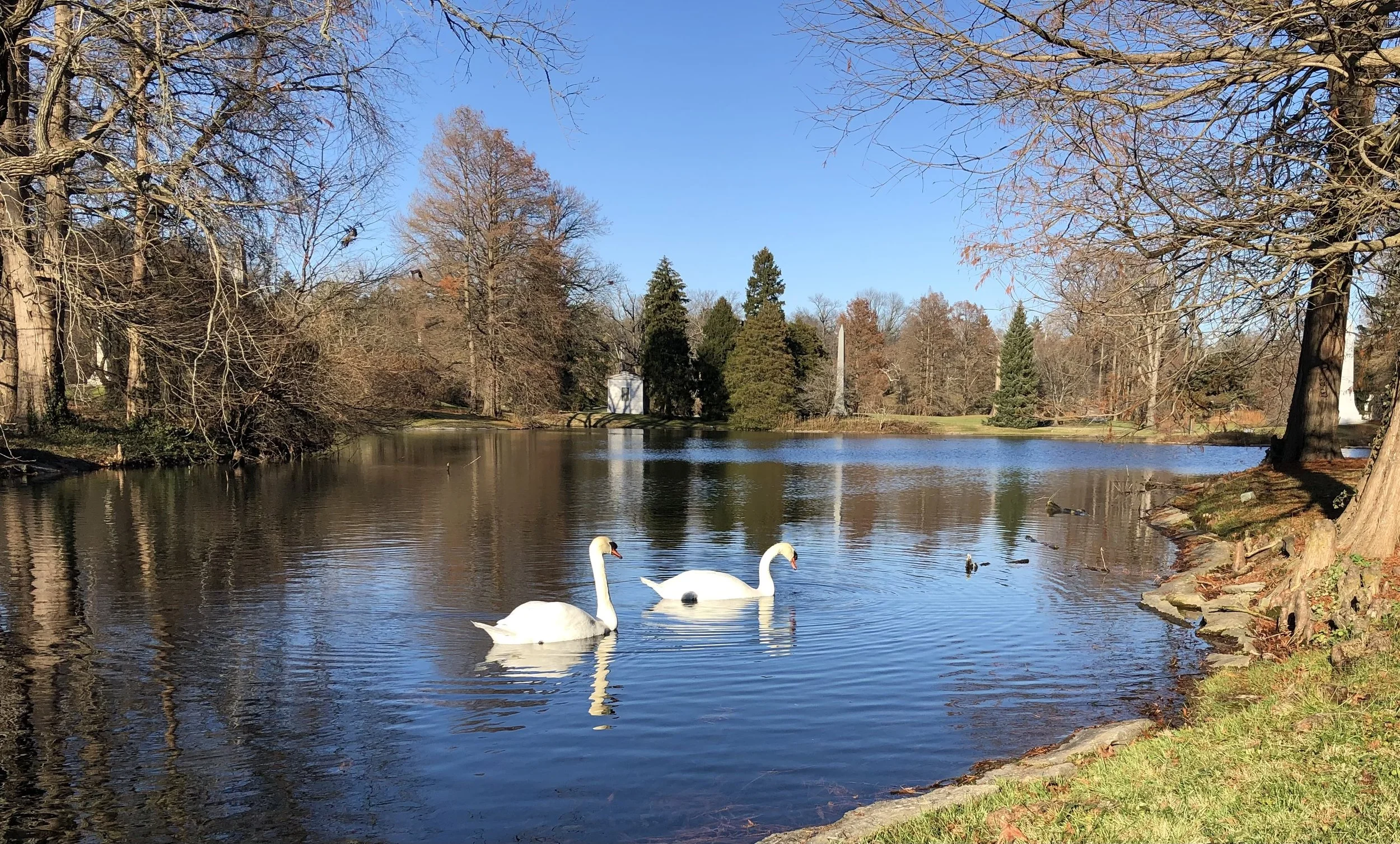
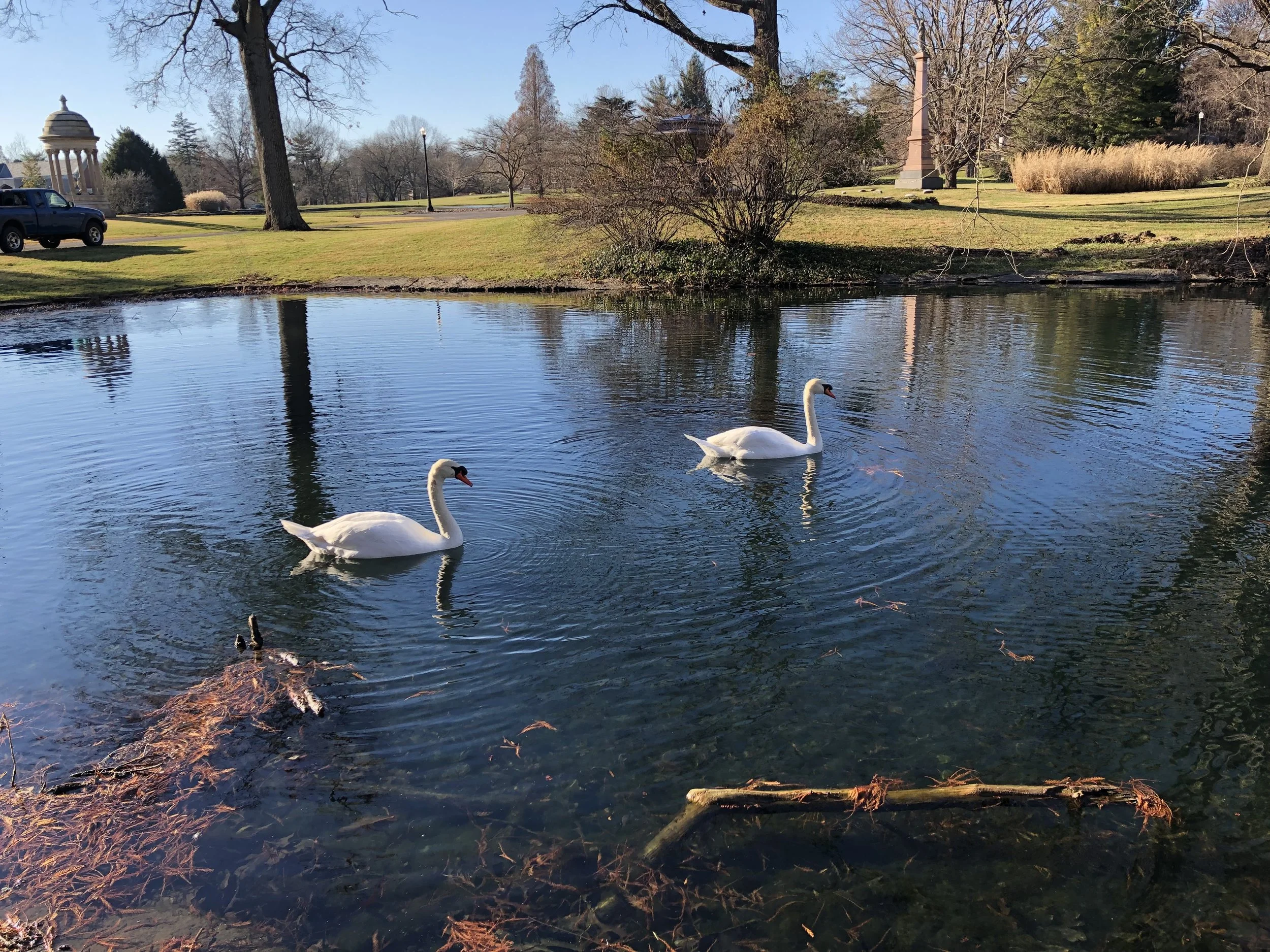
Swan Lake at Cincinnati’s Historic Spring Grove Cemetery
Swan Lake at Cincinnati’s Historic Spring Grove Cemetery
Planning is a Beautiful Thing
BLOG 12 March 22, 2026
Last week, I led a funeral service—a very meaningful part of the work I do. In preparing, I sometimes use a “days lived” calculator to help put a life’s span in perspective. For Carol, I ran the numbers then typed in my script, “Carol lived 30,983 years.” Although I usually review my notes carefully, that type-o slipped right past me until I was standing up in front of 50 of Carol’s closest family and friends delivering her service.
AN OOPS MOMENT MEETS REALITY
Here’s how that moment played out: “Carol lived 30,983…Ohhh, I wrote years here.” Surprised by my own blunder I spoke it out loud. We all chuckled—a little levity at a funeral being a good thing. But 30,983 years? Only the earth has ever lived that long! I’m glad I didn’t say that though. I would have blundered again. It’s estimated that some nematode worms have lived in permafrost for 32,000 years!
It’s true, most mammals get a relatively short time here on earth and let’s be honest, the human kind are not happy about this—at all. Generally, we don’t like to talk about death. Our own death or anyone else’s for that matter. Death is a confronting topic, as a therapist friend of mine has said. And because we don’t like to talk about it we leave our loved ones unprepared for it. Our loved ones, equally uneasy, often stay silent instead of asking important questions.
Life, of course, is unpredictable. We don’t always know when we are going to die. Accidents happen—the kind that take lives, not spill milk. Sudden death happens too and at all ages. I have personally known of a 25 year old and a 42 year old who died unexpectedly as did my father-in-law at 63 and my own father at 76. Last week I officiated a service for a 65 year old woman who died in her sleep. Sometimes families just have to pick up the pieces and figure things out. But certainly, if we’re fortunate enough to reach our senior years, making a plan can be the greatest gift we give our loved ones.
PLANNING AHEAD IS A GIFT FROM BEYOND
Carol, who truly lived 30,983 days, understood this. As her health declined during her 84th year she openly talked to her children about the plans she had in mind when the time came. Because she was a devote Catholic, her children assumed their mother would want a traditional funeral mass—but Carol set them straight sharing her real wishes. And they gave her a gift in response, the gift of honoring her wishes because they knew what those wishes actually were. By having these honest talks, Carol gave her family the gift of clarity and peace, making things much easier during a difficult time. Her children, in turn, honored her by following her plan—a true gift back to her.
Carol’s experience reminds us how important it is to have open conversations and clear plans for our own wishes, so our loved ones are prepared and can honor us as we hope. Just as Carol thoughtfully planned ahead, many families find peace when these difficult conversations happen before it’s too late.
Is it time for you to think about your own plans?
Or maybe it’s time to sensitively ask your parents about theirs?
These conversations may feel awkward at first, but they can save a great deal of heartache later on.
WISHES CAN COME TRUE IN MEANINGFUL WAYS
When Carol’s time came, her plans worked beautifully. We held a thoughtful, heart-warming service at Spring Grove Cemetery’s onsite funeral home—complete with her favorite music, the special words and prayers I prepared for her, and a photo-remembrance of her life. Afterward, we processed to her gravesite for a Catholic burial led by a priest from her childhood parish, and I closed with her final request: “an oldie but a goodie”—as I said before singing “Auld Lang Syne.” Then her loved ones returned to Spring Grove’s Event Center and gathered for refreshments and fellowship. Everything unfolded just as Carol wanted.
So, what about you? What do you want?
I’d love to hear your thoughts or questions. And I’m always happy to offer guidance, and maybe a little laughter if you need it; type-os optional.
Gratefully yours, Donna
P.S. If you find my blog articles helpful I hope you will forward these emails to friends and relatives who you think may benefit from my gentle musings.
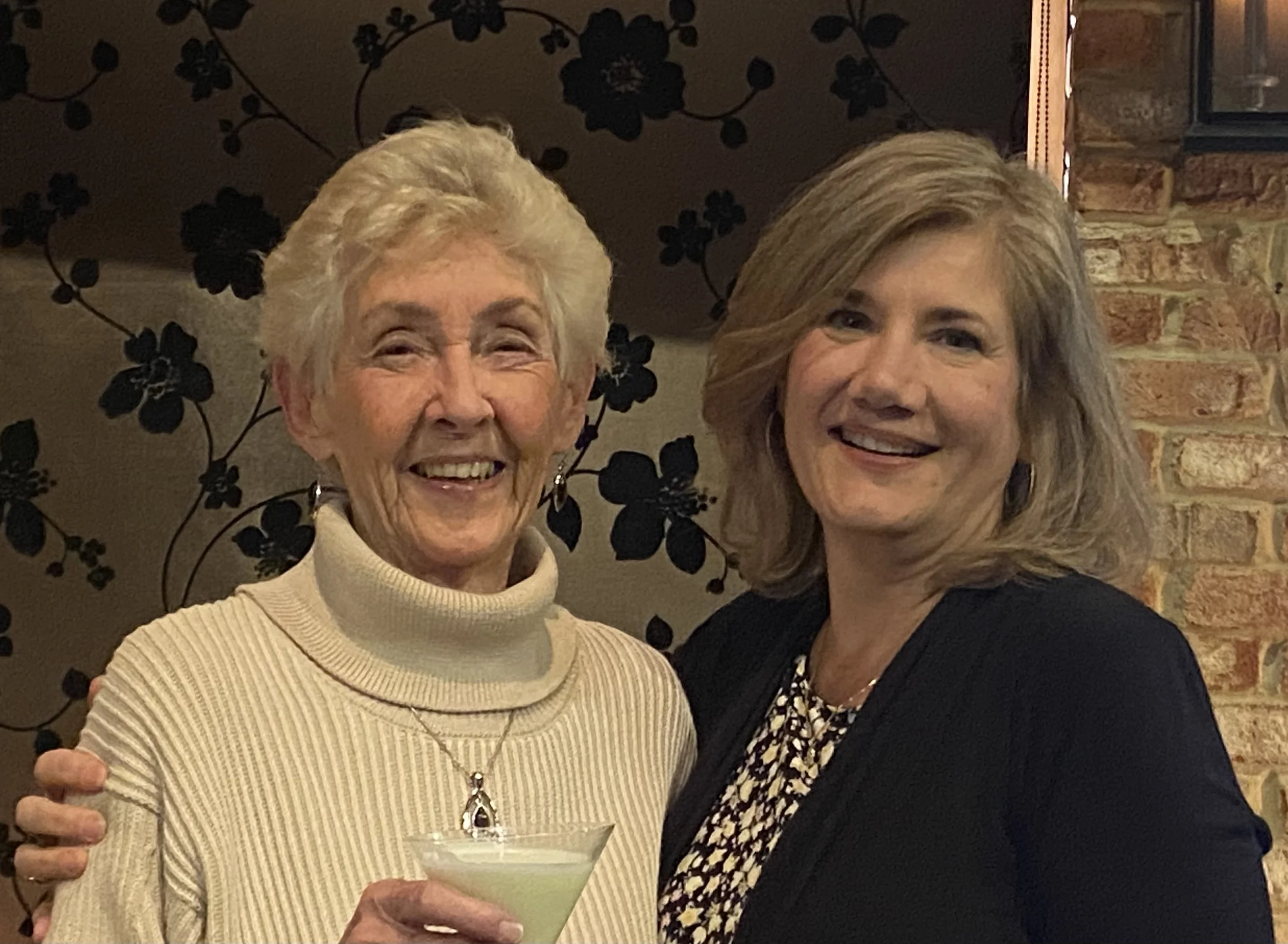
Me with my friend Anneliese at her 80th birthday party. First we worked together, then we became friends. That was 40 years ago and now I’m on her “list”.
In Case of Death Call…
BLOG 11 March 1, 2026
My dear friend Anneliese turned 82 in February. She recently shared with me that she keeps a list of people to be contacted when she passes away. Anneliese is not currently ill or suffering from any ailment—she simply understands that none of us are immortal. Most of us, however, avoid contemplating our mortality or making preparations for it. We tend to shy away from considering the practicalities of death, even though we will not be present to manage them ourselves. Nonetheless, someone will have to, and it is important to think about that person—whether it's a daughter, as in Anneliese’s case, or perhaps a son, spouse, niece, or nephew. Where the responsibility falls ultimately depends on one’s family situation, of course.
Considering Our Loved Ones
Anneliese has taken the time to consider these matters. She made a list and informed her daughter where to find it. She is confident that her daughter and granddaughters will make the necessary phone calls when the time comes. All of us who love Anneliese hope to have many more years with her, just as she wishes to share many more years with us. Yet life is unpredictable and anything can happen at any time. It is wise to be prepared for such eventualities.
A recent story from The Washington Post illustrated this point with humor. The article described a man who pre-wrote a postcard announcing his own death and asked his daughter to send it to the hundred people on his mailing list after he was gone. He approached the subject in a good natured and funny way. His postcard read, “If you are reading this I am dead and I really liked you.” By preparing his own list, he ensured that everyone he valued would be informed, avoiding the possibility that some might be overlooked because his family was unaware of their significance to him.
Emotional Value in Preparation
I find this idea both touching and meaningful. It serves a dual purpose: not only does it ensure that important people are notified, but it also allows you to reflect on all the relationships that have enriched your life—and the lives you have touched in return. Creating an inventory of the people we have liked and loved, at least those who are still with us, is a heartwarming and edifying exercise.
There are many things in life we cannot control, including when our time to “go” will come. That is why it is empowering to take charge of what we can. Making these kind of preparations is a true gift to your family, sparing them additional stress by making it easier for them to manage the details after you are gone.
So who is on your list? You are on mine!
Until next time. Gratefully yours,
Donna
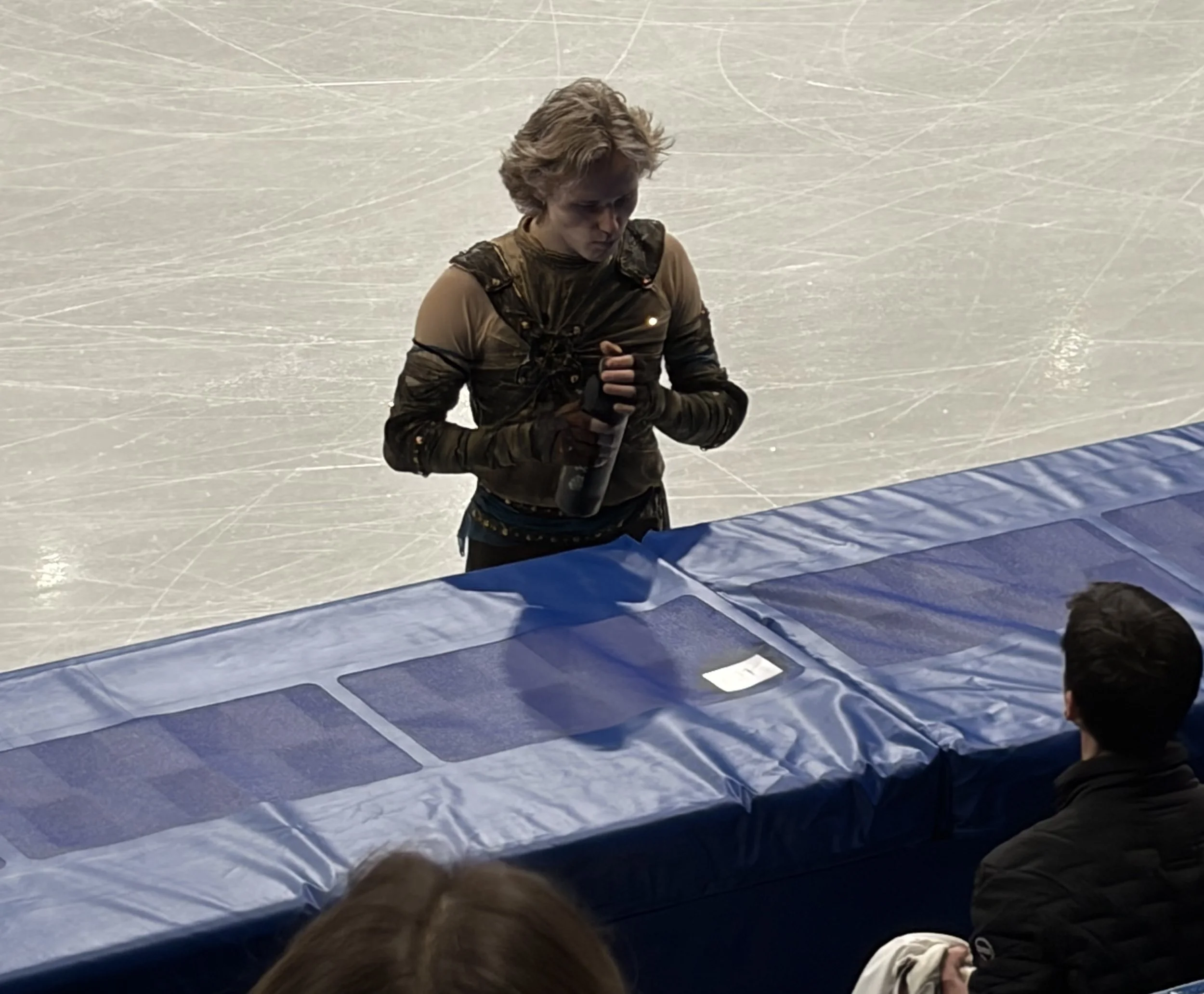
Ilia Malinin prepares to skate his short program at the Milan- Cortina 2026 Winter Olympics. Photo Courtesy of Diana Behrendt, friend and Olympic spectator.
Olympic Dreams Can Come True at Any Age
BLOG 10 February 15, 2026
Last week, my friend Diana had the incredible opportunity to attend the Olympics. When she returned, she sent me a text inviting my husband and me to join her and her husband for dinner on Valentine’s night. My playful response was, “So you can brag about going to the Olympics??? I don’t think so.” Of course, I was joking—and I made sure to add plenty of laughing emojis so she’d know it!
Later Years, New Adventures
At dinner, I truly enjoyed hearing about their four adventurous days in Milan, Italy. Diana and her husband saw Ilia Malinin skate the short program in men’s figure skating, and they were so close to the rink that Diana snapped a fantastic photo of Ilia right before he skated to center ice to begin his performance. They also witnessed speedskater Jordan Stolz win Gold and set an Olympic Record.
What made their story even more inspiring is that Diana and her husband aren’t “movers and shakers.” They’re ordinary, middle-class folks—just like my husband and me. Now, as empty nesters, they have a little more flexibility than they used to, and decided to treat themselves to this trip, something they’d never done before.
You might be wondering what this has to do with insights on elder care. In my view, it has everything to do with it. Their adventure really got me thinking about how important it is for people approaching their senior years to embrace new experiences.
Breaking Out of Old Patterns
My friends aren’t quite elders yet, but they’re in their late 50s and mid-60s. They’re still healthy, energetic, and now have a bit more means than before. They’ve chosen to prioritize themselves and finally do things they’d only ever dreamed about. Truly, if not now, when?
People can easily get stuck in their ways, focusing on what’s right in front of them instead of what could lie ahead. The possibilities can feel intimidating—new things we’ve always wanted to try but now seem a little scary. Yet, trying is exactly what we need. It stretches our mental muscles, and once stretched, anything feels possible. One thing leads to another, and before you know it, you’re an active retired senior, not a tired, inactive one. Which would you rather be?
Preparing for the Future While Enjoying the Present
There are no guarantees in life, but research shows the benefits of staying active as we get older. We’ve all heard the phrase from that TV commercial: “A body in motion tends to stay in motion.” Isn’t that what we all want? By trying new things, we keep ourselves moving—and that alone can help stave off degeneration of mind, body, and spirit.
If we’re lucky enough to age well into our elder years, we need to be prepared. Have your Will and Power of Attorney documents in place. Make sure you have some money in the bank. But, in the meantime, don’t forget to enjoy yourself. You’ve earned it.
Looking Forward
So, what new adventure will you try this year?
The Olympics have one more week to go!
Do you believe in miracles?!
Until next time. Gratefully yours,
Donna
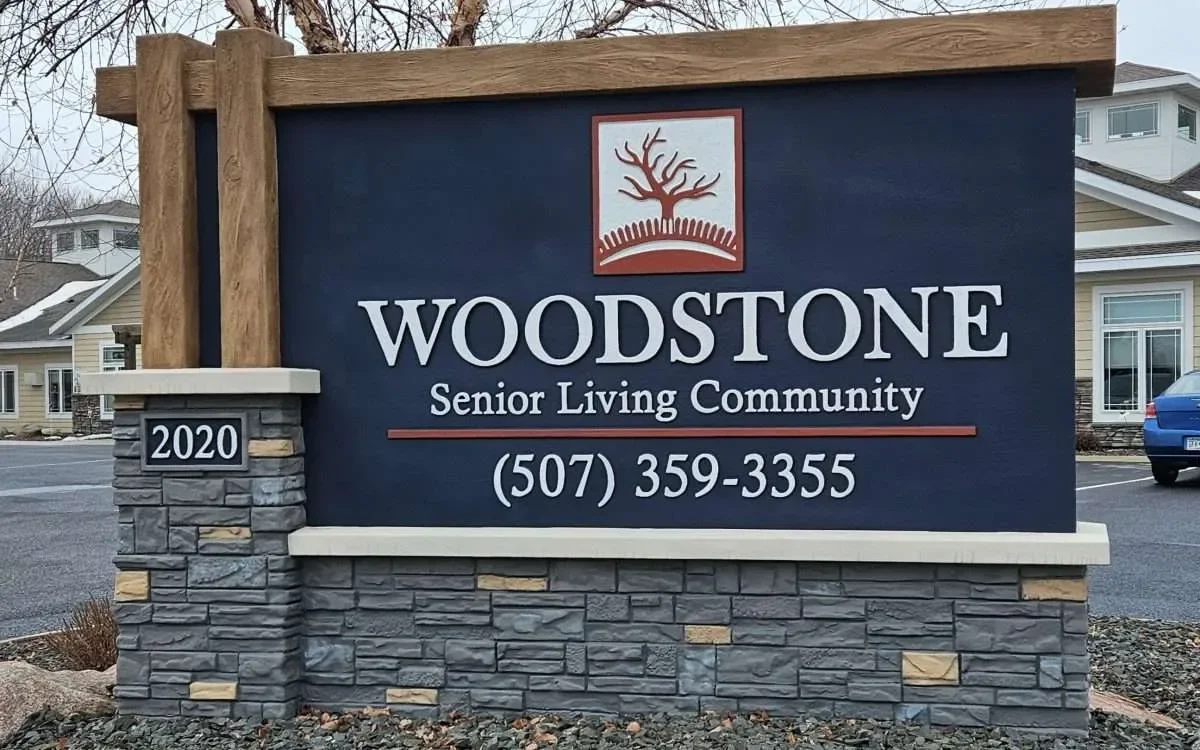
It never occurred to me to take a photograph of the sign where my mother live for the last 31 months of her life. But here is an example of a beautiful sign and appropriately labeled senior living “community” !
Is it Facility or Community? Words Matter.
BLOG 9 February 1, 2026
THE POWER OF LANGUAGE IN THE SENIOR LIVING WORLD
Not long ago, I saw a TV commercial for a senior living place that used the word “facility” in its advertisement. I cringed. Hearing that word on air made me wonder how such language still slips into public conversation—and how the people living in that community would feel about it if they knew!
Words matter—deeply. They shape how we see a place, how we feel about those who live there, and even how residents see themselves.
Think about it: If someone asks you, “Where do you live?” you’re likely to answer with “a house,” “a condominium,” or “an apartment.”
No one would say, “I live in a facility,” and who would want to? So why do we use that word when describing places where our parents, grandparents, aunts, uncles, neighbors, or friends live in their later years?
Yet, when our loved ones move into a place that fits their retirement years or changing bodies, we often still call those places “facilities.” It’s a word that carries the chill of institutions, not the warmth of home.
When my mom moved into a memory care community, I made a conscious choice to call it a community. It already felt hard enough for her to leave her beloved home of 35 years; I refused to make it harder by using language that stripped away her dignity. Calling her new place a community was more than semantics—it was an act of respect, a way to help her feel valued despite the major change in her life.
Officially, Mom moved to The Sheridan at Cooper City: An Assisted Living Community. The sign out front said “community,” not “nursing home” or “facility.” Inside, older adults lived together and got the help they needed, but it felt like a neighborhood—like home. There were individual “homes” built around central meeting places, and in the memory care area, three hallways of apartments were called neighborhoods. Each neighborhood had its own living room, dining room, and kitchen. A beautiful courtyard with a walking path connected the neighborhoods.
Mom’s apartment was cozy—a large single space with a bathroom, bed, nightstand, dresser, television, an overstuffed side chair, and a bench with baskets underneath. We always called it her apartment instead of her room, even though “room” was easier to say. I slipped sometimes, but I tried to remember, because those words mattered. I wanted Mom to feel dignified, not diminished, as she adjusted to her new home. The language we used was part of maintaining that dignity
Not all senior living communities are created equal. We were lucky—Mom’s was one of the nicer ones. But even places that look more like a “facility” than a community deserve respect. Many older buildings were designed in a time when nursing care meant hospital-like environments and many of those are still in use today. But language can help us shape reality: The more we call a place a community, the more we work to make it feel like one for those who live there.
PERSON-CENTERED LANGUAGE: More Than Semantics
My mom’s story reflects a broader shift happening in elder care—one where language shapes not just perceptions but actual life experiences. This shift in word use is called person-centered language and it is gaining ground across the country. It’s about more than swapping out words. It’s about believing in what those words stand for. It’s about creating environments where respect and dignity come naturally. These are modifiers at the core of person-centered language:
Instead of Facility/Institution, use Community, Home, or Neighborhood.
Instead of Patient, use Resident, Person, Individual, or Member.
Instead of Elderly, use Older adults, Seniors, or Elders.
Instead of Handicapped, use Person with a disability.
Instead of Alzheimer’s or Dementia Unit, use Memory Care or Memory Support Area.
Instead of Dining Room, use Restaurant, Cafe, or Bistro.
Of course, not every suggestion fits every person’s idea of home—personally, I like “dining room” because it feels homey. After all, who eats at a restaurant or bistro every day? (But I do appreciate communities that offer various dining choices, because having options gives residents agency over their daily lives but that’s a whole other topic!)
WORDS IMPACT WELL-BEING
Studies even show that when older adults are called “residents” instead of “patients,” they report feeling more respected and at home. One research article found that when staff members use person-centered language they are more likely to foster positive relationships with residents, leading to better overall well-being and satisfaction. For families, hearing their loved one referred to as a “community member” rather than “patient” or “facility resident” can ease feelings of guilt and anxiety about the transition. It’s not just about feeling good—it’s about supporting mental health, self-esteem, and genuine connection for both the residents and their loved ones.
NORMALIZING THE TERMINOLOGY OF TOMORROW
Language matters. It honors people, their stories, their histories and their very lives. As caregivers, families, and community members, we have the power to shape the experiences of those living in care communities through the words we choose. Let’s commit to intentional language choices making dignity the foundation of every conversation in elder care. Our efforts today will create the normal language of tomorrow.
Please email your thoughts on this and where you are attempting to use person-centered language. We can do this together to benefit us all.
Gratefully, Donna
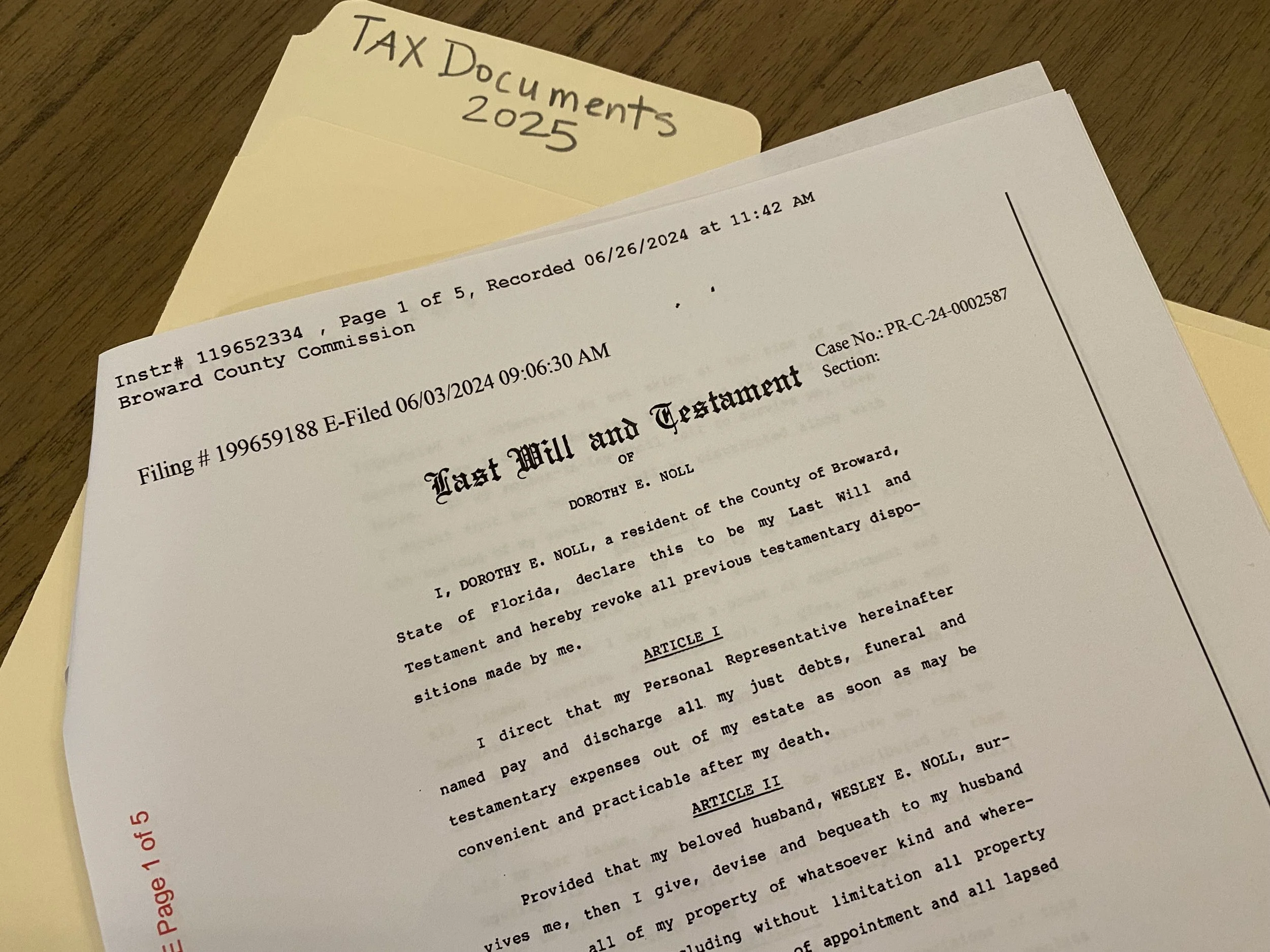
In Uncertain Times Two Things Remain Certain: Death and Taxes
BLOG 8 January 16, 2026
Some people are saying that we are living in uncertain times. While there are always regions in the world experiencing strife, conflict, and instability, it does feels as though certain things in our own country are particularly “off” compared to how we have traditionally viewed them. Yet despite these uncertainties, there are two things we can always count on: Death and Taxes. It’s January, which means your tax documents will soon arrive in the mail, and inevitably, someone you know—or know of—will pass away this year. How can we be prepared for these certainties?
Preparing for Tax Season
Dealing with taxes is the simpler of the two certainties. You know what to do. Start a file folder, whether physical or digital, to collect all your 2025 tax documents. Order your preferred tax software, such as TurboTax, H&R Block, TaxSlayer or E-File. If you use an accountant or a local tax preparation service, gather your tax information as early in February as possible and drop it off at a tax office near you; maybe even the one with the dancing mascot on the street corner! Your choice, of course! For those earning less than $84,000 a year, there are programs that offer free tax assistance. My husband and daughter have both volunteered with VITA (Volunteer Income Tax Assistance), where certified IRS preparers help at locations like public libraries. Check online or ask your librarian. No matter what your tax situation, though, this is the easier of the two certainties to address.
Confronting Death
The more challenging certainty is death. We all face it eventually. A therapist colleague recently described the topics I write about as “confronting,” and I realized just how correct she was. In this sense, to confront means “to cause to meet; bring face-to-face,” such as confronting someone with statistics or, in this case, with the reality of death.
Between November 1 and December 29, I was confronted by death eight times. I witnessed profound loss for many people. I performed four services at Spring Grove Cemetery—including one for a friend’s mother—faced the death of a 40-year-old community theater friend of my son, attended a funeral for another friend’s father, learned of the passing of yet another friend’s mother, and heard that a father figure to my nephew-in-law had died three days before Christmas. After leading a service on December 29, I was emotionally exhausted. I think I am still working to regain my balance even now in mid-January.
My experience may be unusual—given my profession—but everyone must face death, and statistically, most of us will encounter it in some way this year. It could be a co-worker’s mother or someone in your immediate family. Death is certain, but it is also a natural part of life. My role is to remind you of that truth. None of us can go through life without facing it.
Emotional and Practical Preparedness
Accepting and confronting the reality of death demonstrates emotional maturity. Taking the next step—being practically prepared—shows maturity in handling life’s responsibilities. So I ask you, do you have a legal Last Will and Testament? Do your loved ones know about it, and would they be able to locate it when the time comes? Do your parents have a Will, and could you find it if necessary? Is it in a safe deposit box, and if so, where is the key? If it is in a safe at home, who has the combination? Addressing these details makes things easier for those we leave behind when we are confronted by death.
Taking Action: Make the Year Count
If you already have a Will, congratulations—you are among the minority. In fact, about 70% of people do not have a Last Will and Testament. Their families may face some challenges because of this lack of preparation. But if you are in that 70%, as long as you are still alive, well, it’s not too late to get it done! Death can be confronting, but it is also confusing if you are not ready Get ready while you still can!. Let 2026 be the year you create your Will, because the only things we can be certain of are Death and Taxes.
Gratefully yours, Donna
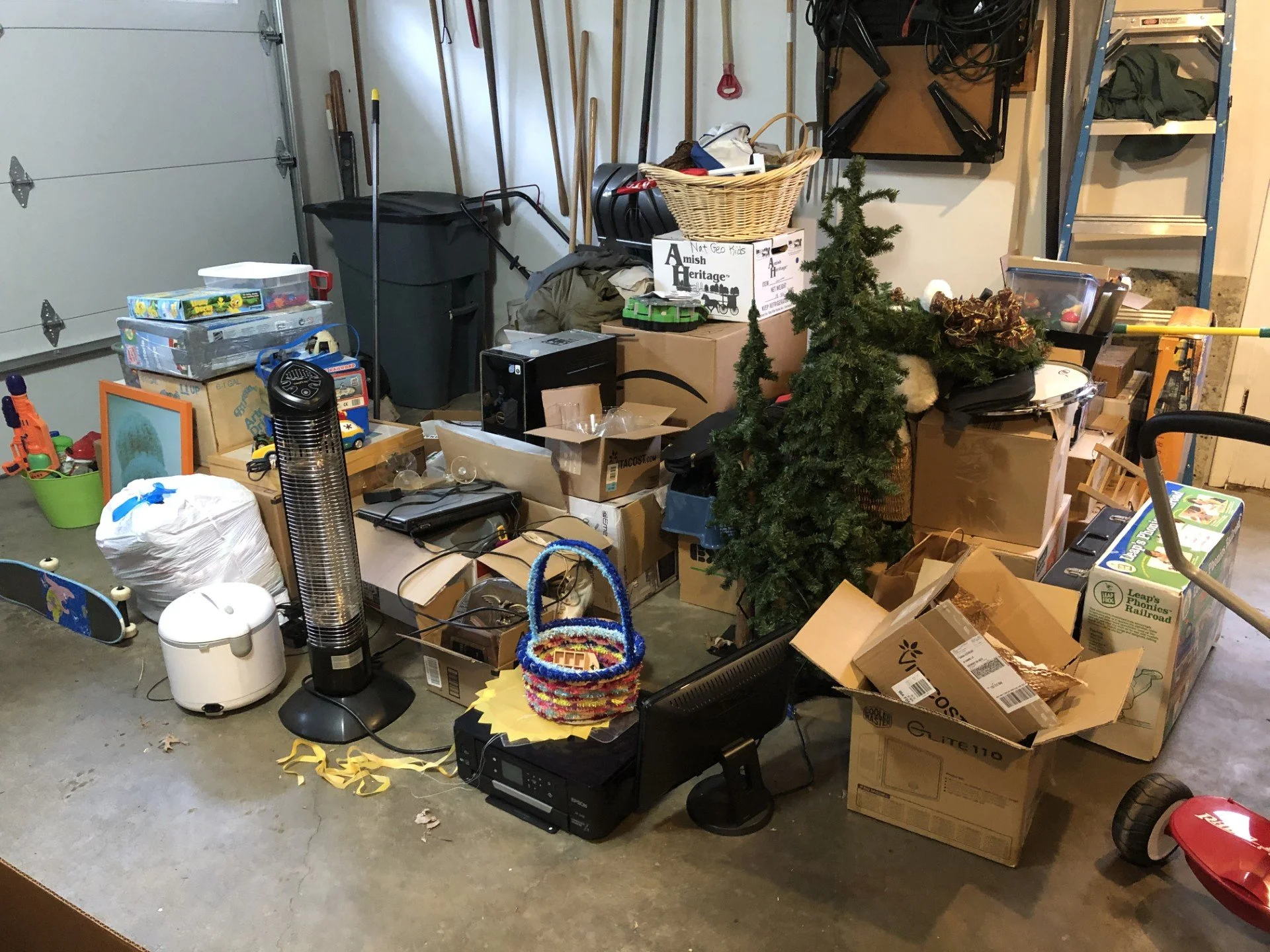
My big attic and basement clear out in 2020
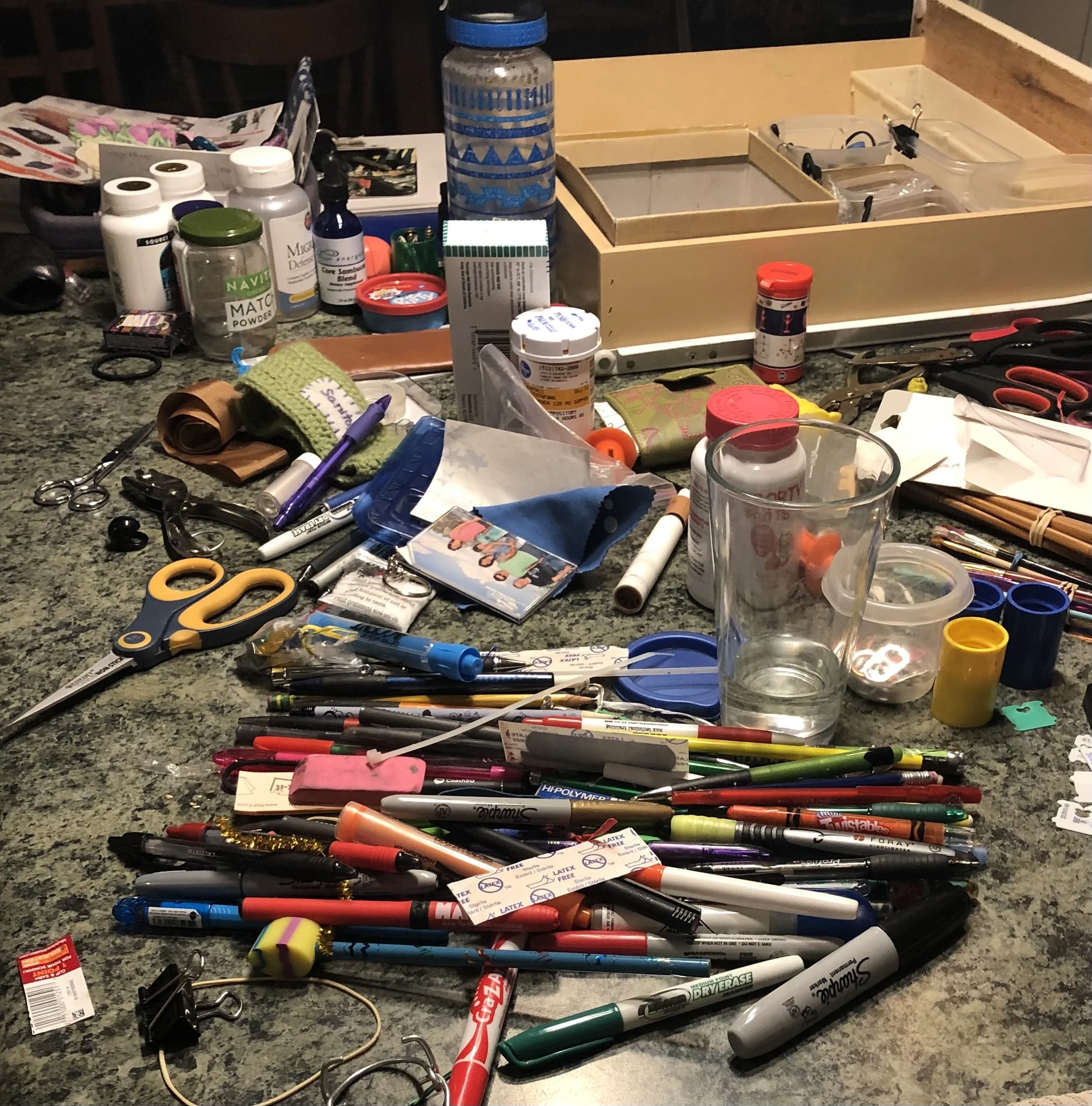
You can start with just a junk drawer!
THE NEW YEAR’S CHALLENGE OF PARING AND PITCHING
BLOG 7 January 2, 2025
Season’s Greetings! While it may seem unusual to offer such a greeting on January 2nd—traditionally more of a December sentiment—I like to think of the start of the new calendar year as the beginning of a fresh season. This time of year naturally invites us to pursue new beginnings, inspiring us to set New Year’s resolutions and seek out fresh starts. Truly, it is a new season in more ways than one.
New Year, New Season and The Art of Paring and Pitching
On December 15th, I shared the story of saying goodbye to our family’s heirloom piano—a meaningful and challenging step in the journey of clearing away clutter and letting go of possessions that no longer serve us. At that time, I promised to remind you that the start of the new year is a wonderful opportunity to begin this process. I call it "Paring and Pitching": the act of reducing your possessions and letting go of what you no longer need. This is also an ideal time for sorting, organizing, and labeling the items you keep.
Facing the Reality of Change
As we or our loved ones grow older, the reality sets in that life is finite. With that, we have a responsibility to manage the belongings we have gathered throughout our lives. Managing our possessions doesn’t mean disposing of everything; rather, it means thoughtfully handling our things. Consider how you might better organize your belongings now, so that, when the time comes to part with them, the process will be much smoother.
Inspiration from around the World
It doesn’t have to be done one way. Combining organizational approaches can be more effective. For instance, Margareta Magnussen’s The Gentle Art of Swedish Death Cleaning: How to Free Yourself and Your Family from a Lifetime of Clutter encourages us, around age sixty, to begin paring down to the essentials so our children are not left with a burdensome task. (I mentioned Swedish Death Cleaning in my last blogpost.) In contrast, Marie Kondo’s The Life Changing Magic of Tidying Up: The Japanese Art of Cleaning and Decluttering suggests letting go of items at any stage of life when they no longer bring joy or serve a purpose and then better organizing what remains.
Letting Go vs Organizing
These two philosophies are not mutually exclusive. For instance, while I parted with the piano, I also installed shelves in several closets to better organize what I still have and use. By labeling boxes and bins, everyone knows exactly what lies within!
Looking ahead, when I retire from work that requires office supplies, it will be simple to let go of those items because they are already separated from other belongings. Similarly, when my “making days” days are behind me, I will be able to donate my crafting materials, which are already organized together.
Preparing for the Future
Some belongings—like a couple totes of keepsakes from my children’s childhoods—remain in attic storage, waiting for the right moment. One day, those items may be show and tell for future grandchildren before being donated or discarded. While some moms I know have already parted with all their children’s keepsakes, I’m not quite ready, and that’s perfectly fine. The important thing is being organized for when that time arrives.
Family heirlooms can be labeled or notated so that adult children understand their sentimental and financial value. If these items remain after we’re gone, clear labeling will help our loved ones more easily manage them.
Modern Tools for This Task
With the ubiquity of digital cameras on our phones, it’s easier than ever to photograph and label items. These photos can then be easily organized into virtual folders, further simplifying the process of keeping track of important possessions.
Some people may need assistance with decluttering and organizing, and there are professionals who offer such services for a fee. If you need help and it’s within your means, these experts can be found through a quick internet search.
A Nice Nudge from Me
However you choose to approach it, January is an excellent time for some "Paring and Pitching." I promised I’d nudge you about that so consider yourself, well, nudged. Now go find something to throw out or label as we all responsibly embrace this new year together!
Gratefully yours, Donna
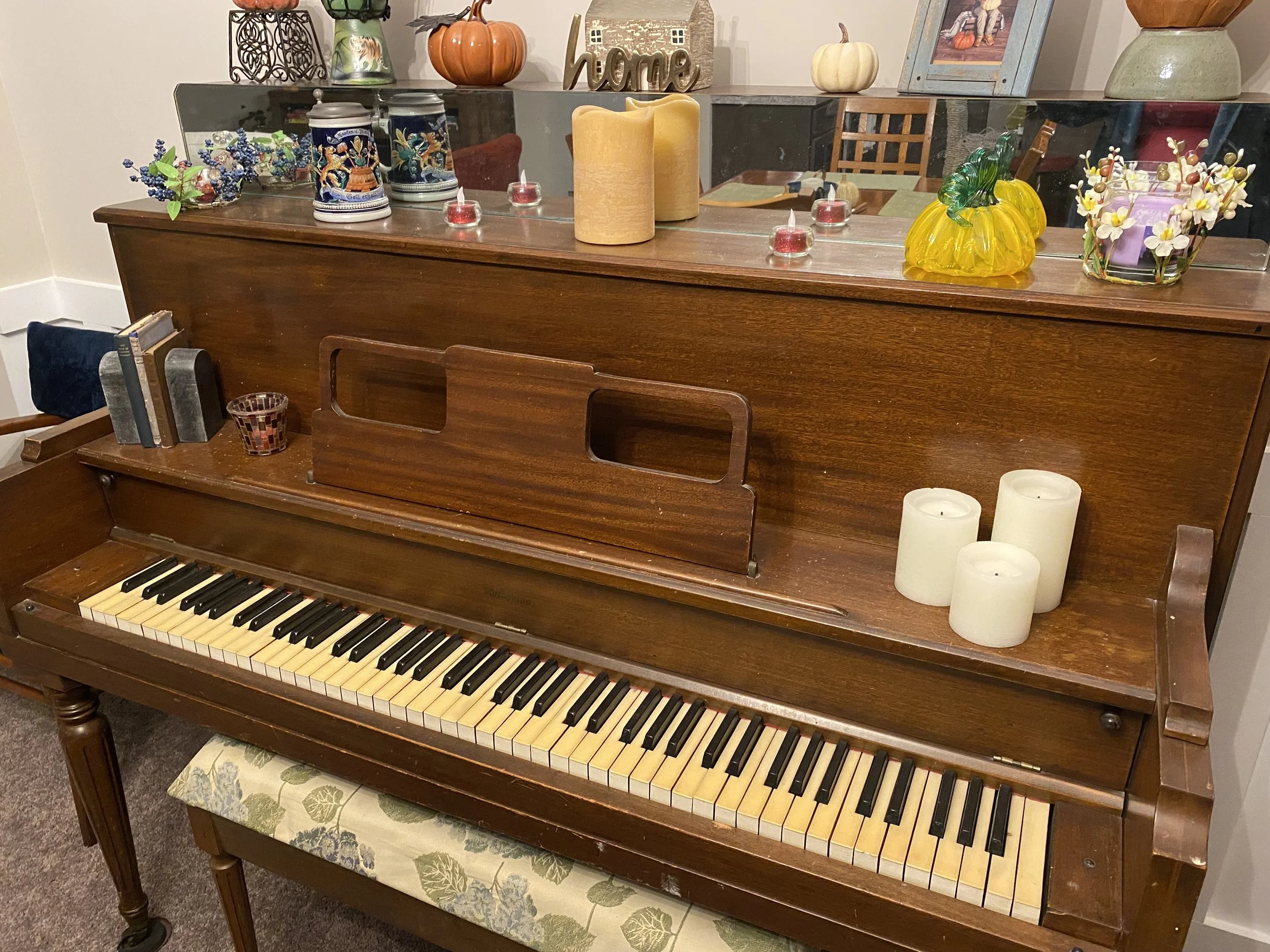
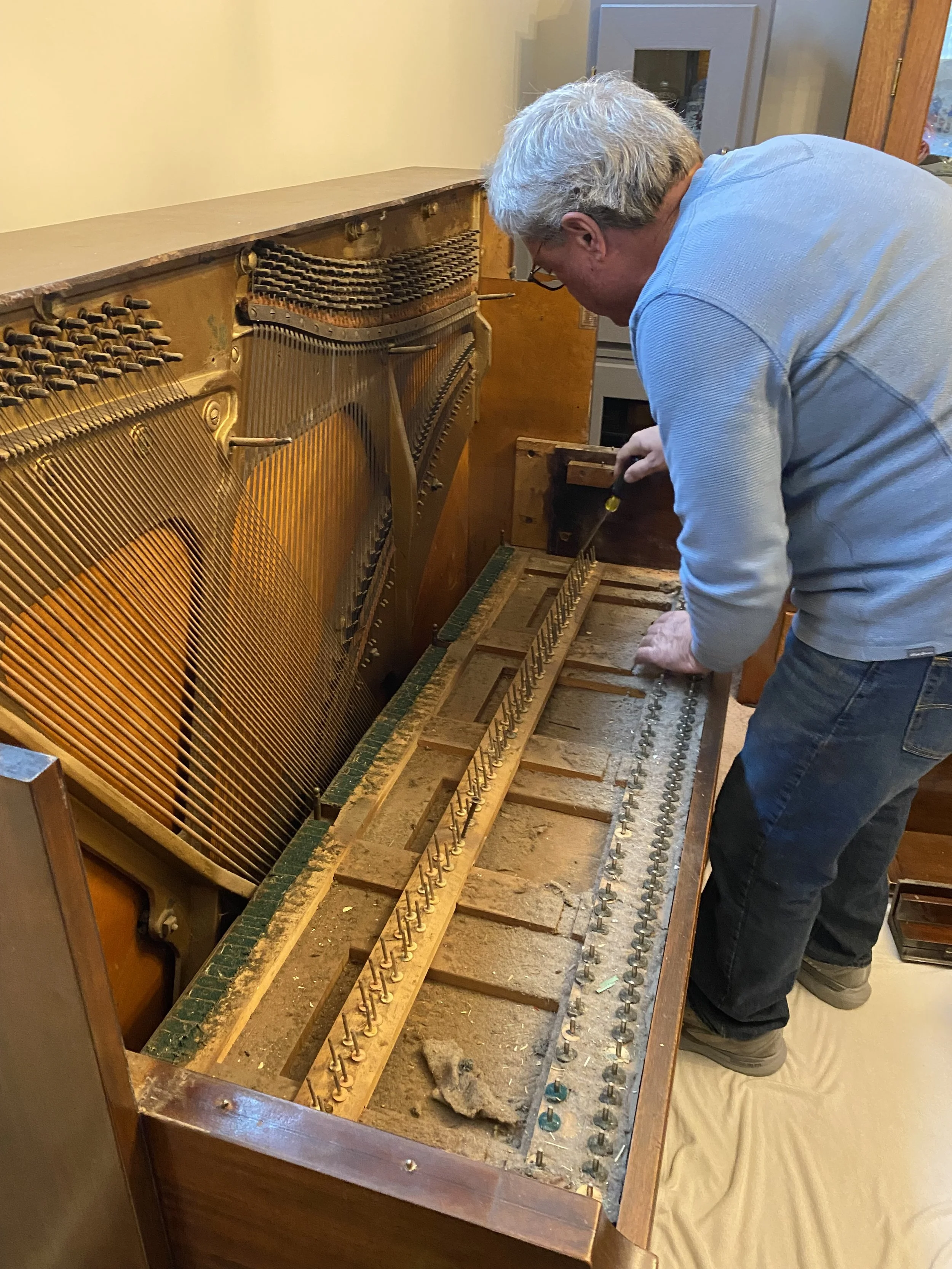
A JOURNEY WITH THE FAMILY PIANO: We Can Do Hard Things
BLOG 6 December 15, 2025
Last week, I made the difficult decision to let go of my family’s heirloom piano which was not an easy thing for me to do.
A PIANO STORY
The piano was 115 years old. I’m not sure exactly when it entered our family, but my mother and her sister both took piano lessons on it in the 1940s, so I know my grandparents had it by then, if not earlier. (And if may have come from another family member.) In 1970, when my grandparents moved to Florida, the piano came to live with us. Later, in 1987, when my parents also moved to Florida, they left the piano to me.
Even though I never learned to play well, I was determined not to let the piano go. Before my parents’ belongings headed south, the moving truck dropped the piano at the house my husband and I had just bought. For years, I jingled around on it and used it to tap out arpeggios when I took up singing lessons. Then when my kids came along, I had piano dreams for them that never came true.
Still, I couldn’t bring myself to part with this piece of musical furniture. It looked impressive and served as a beautiful display for decorative items, family photos, and my Christmas village. Eventually, I stopped having it tuned and hoped one day to replace it with a small grand piano—telling myself I’d finally learn to play again (and better!) when my kids were older. However, the space, time, and money for my grand dreams never materialized. Over time, the old piano became more of a glorified shelf, and its bench a nightly coat rack.
MOVING AND FACING THE MUSIC
Two years ago, we moved to a new house that wasn’t well suited for a piano. Still, the idea of leaving it behind, along with all the memories from my childhood and my years raising my children, was too much to bear. I also couldn’t stand the thought of it being hauled off to the dump, so the piano moved with us. As the grief I felt from the actual move faded, I found myself wrestling with what to do about the piano again.
I found a company that does complete restorations, and for about $10,000, I could have the piano transformed into a playable showpiece, worthy of a spot in my less-than-ideal-for-a-piano new house. But for that same amount, I could buy an impressive grand piano, take an amazing vacation, install hardwood floors, or even get a hot tub! Did spending that much simply to keep the memory of the instrument alive in our family make sense? For me, the answer was finally “no.”
ACCEPTANCE AND RECYLING
It took years to reach that decision. I needed time to grow older and recognize my responsibility to manage my belongings, not leaving a mess for my children. In Sweden, they call this process “Death Cleaning,” and people start around age 60. I’m right on schedule with the Swedish Death Cleaning process. I hope to live much longer, but with fewer possessions and fewer worries about what my kids will have to deal with when I’m gone. Paring down comes in stages, and I knew the time had come for the piano to go.
To ease the sorrow of parting, I found someone who creates keepsakes from old pianos. Our piano was unique in that it had a 5-inch mirror running the length of the 88 keys. (You can see that in the photo above.) My piano craftsman will mount the mirror on wood from the piano to make a wall hanging. He will also reuse as much wood as possible and recycle the harp with a metal recycling company. I could not imagine my family piano being dumped whole into a landfill simply because it had outlived its “tunefulness.” Recycling as many piano parts as possible is best for the environment, and in my case also best for the “soul.”
DECLUTTERING AND LEGACY
What creative ways can you use for family heirlooms to give them new meaning and life while not burdening the next generation? How can you begin your own process of Swedish Death Cleaning? How can you encourage your parents to start sorting through their things? The internet is full of information on how to get started. All it takes is a single search. What are you waiting for? Okay, maybe Christmas! Fair enough! The period following the holiday season is a wonderful time to begin clearing and organizing.
I’ll remind you on January 1st. Until then, Happy Holiday Season any way you celebrate! And remember to share my blogs with your friends. We can do hard things together.
Gratefully, Donna
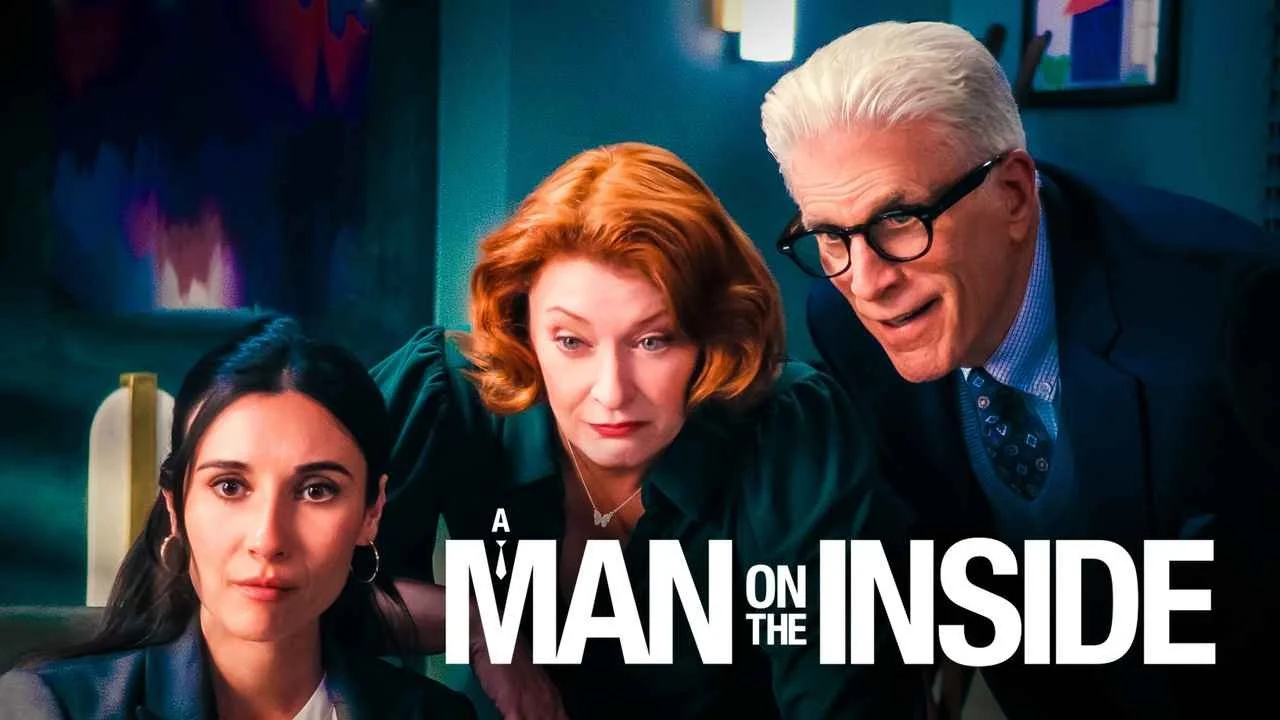
Reflections on “A Man on the Inside” and Senior Living
BLOG 5 December 2, 2025
If you have Netflix, you may be interested in catching Ted Dansen in the delightful new sitcom “A Man on the Inside.” Over Thanksgiving weekend, I watched Season Two, and I found both seasons to be highly entertaining for viewers of any age. However, as someone in her 60s, I was especially moved by the show’s interwoven themes of aging, vitality, love, community and intergenerational connection.
Ted Dansen on Aging with Grace
In season one, Ted Dansen plays Charles, a widower and former engineer who becomes a private investigator. Charles takes on the case of a missing necklace at the Pacific View Retirement Community. Many of us remember Ted Dansen from his younger days as Sam Malone, the charming bartender in “Cheers” during the 1980s—a time when we were all younger. Now, time has passed, and Dansen’s once brown hair has turned to a graceful white. He stands out in Hollywood as someone who embraces the natural aging process, proudly wearing the evidence of his 77 years.
Dansen’s acceptance of aging is reflected in his choice to star in “A Man on the Inside,” where he portrays a 70-something widower searching for renewed purpose. In season one, Charles temporarily moves into a retirement community as a spy to solve the mystery of the missing necklace. At the season’s end, Charles returns to his suburban home but continues to nurture friendships formed during his time in the community. Season Two sees Charles back in action, investigating a new case at a local college while the retirement community remains an important part of his life.
Green Pastures Full of Life
“A Man on the Inside” has received positive recognition, with Rotten Tomatoes giving the first and second seasons ratings of 96% and 91%, respectively. The site commented, “Tailor-made to suit Ted Dansen's estimable strengths, this warm and witty sitcom discovers a lot of life left in those who've been put out to pasture.”
The phrase “put out to pasture” is often seen as negative, but the metaphor of racehorses enjoying green pastures at the end of their careers can also signify a period of relaxation, freedom, and personal choice later in life. Shouldn’t we all look forward to carefree days and fulfilling activities (like secret spy work!) after the long race of life?
Personal Reflections
The show prompted me to reflect on my own family. Sometimes, I wonder how things might have been different for my mother if she had chosen community living after my father passed away. I believe she might have felt less lonely and stayed more active, possibly delaying the onset of dementia, as engaging in activities is beneficial to brain health. While we can’t know that for sure, I believe that a community lifestyle could have added great value to her later years.
Here are some reasons why anyone over 60 might find community living beneficial whether it’s a local retirement community or the infamous Villages in Florida and Arizona where entire “towns” of 55 and older folks have been created.
Key Advantages of Senior Living Communities
Connection and Community
· Social Interaction: Senior living communities offer residents the chance to connect with neighbors through a variety of activities, programs, and outings.
· Sense of Belonging: Living among peers creates a supportive environment, reduces loneliness and isolation, and enhances feelings of value and worth.
Health and Wellness
· Well-Being Focus: These communities promote whole-person wellness through programs that support physical, mental, and emotional health.
· Access to Care: Many senior living options provide convenient access to healthcare services, ensuring residents receive support as their needs evolve.
Maintenance-Free Living
· Reduced Responsibilities: Residents benefit from maintenance-free living, as housekeeping, yard work, and other chores are typically managed by the community.
· Consolidated Expenses: Traditional senior communities can simplify finances by combining housing costs, utilities, and meals into one monthly payment.
Safety and Security
· Secure Environment: Senior living communities generally offer a safe environment with security personnel and emergency response systems.
· Peace of Mind: Residents enjoy peace of mind knowing help is available if needed.
These advantages make senior living communities an attractive, even logical, choice for older adults seeking an active, engaged lifestyle.
Final Thoughts
My mom cherished her modest ranch style home on Florida’s intercoastal waterway, enjoying the scenery, sunsets and wildlife. But as she grew older and after my dad died she spent less and less time with other people. And although she wouldn’t admit it she became more sheepish about air travel so visiting her four kids came to an end; since we all worked and had families it was hard for us to visit frequently. As we watched our mother’s world diminish, she still resisted the idea of leaving her house for a retirement living lifestyle. This was her prerogative, of course, only we preferred that if she stayed in her home she was able to do so with a broader support network. Since she lacked that we believed she would have been an excellent candidate for community living.
Looking back, we wish we’d discussed her living situation sooner and more earnestly. What important conversations should you and your loved ones have now, rather than waiting?
Please share your thoughts or questions with me and forward this email onto someone who might benefit from reading it. If you haven’t already signed up to receive my blog direct to your email you can do so at www.elderjourneyinsights.com.
Gratefully, Donna
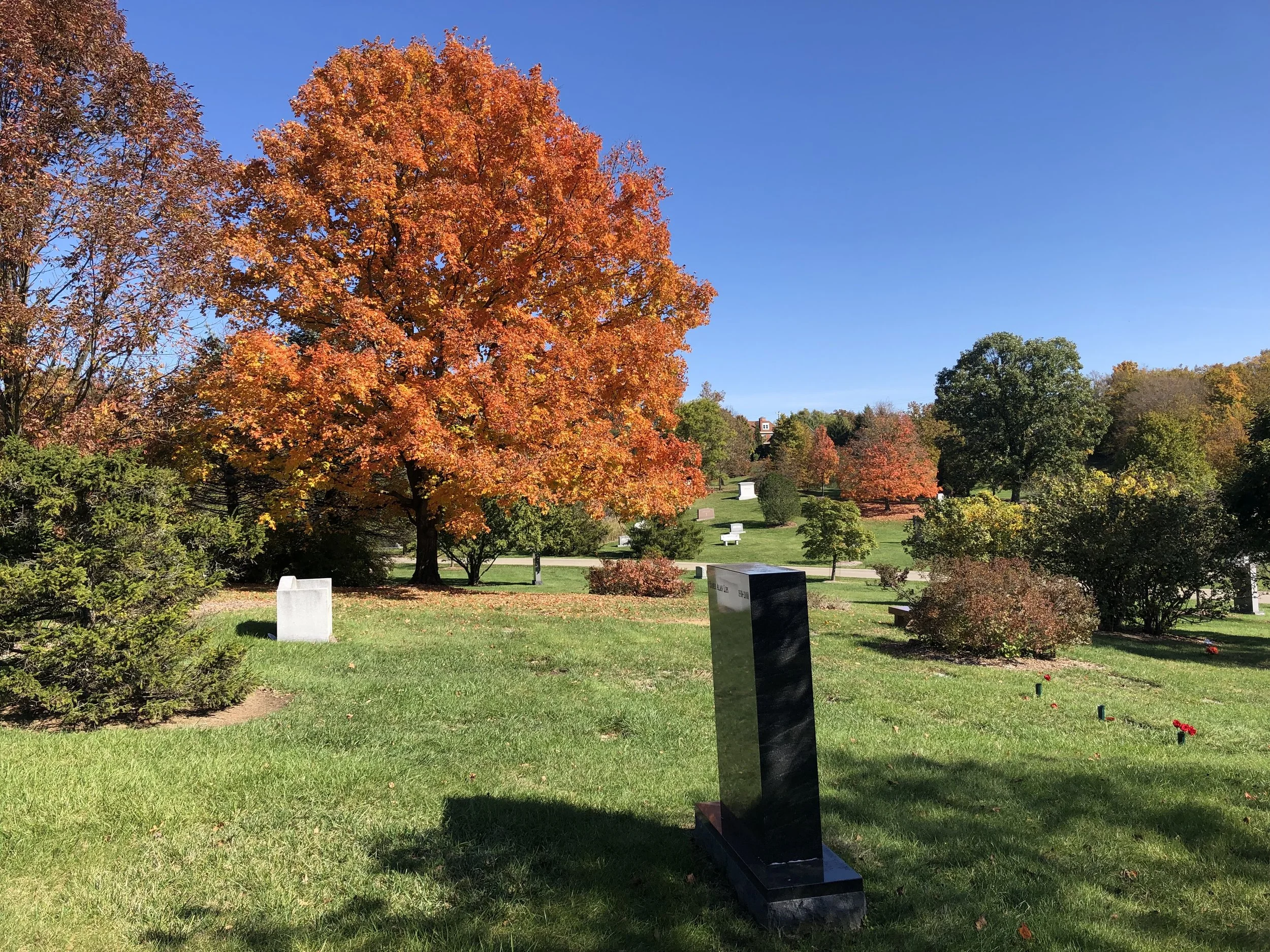
Cincinnati’s Historic Spring Grove Cemetery where Donna performs funerals service.
Lessons from the Sandwich Generation:
Juggling Life, Work, and Elder Care
BLOG 4 November 17, 2025
We’ve all heard the saying, “Life is what happens when you’re making other plans.” I certainly have. Recently I set out with the best of intentions to publish two blog articles every month—on the 1st and the 15th, like clockwork. Sometimes, though, life’s unexpected turns take priority, and our carefully laid plans get pushed aside. As did my blog for November 15th! Balancing Responsibilities
Sometimes writing for Elder Journey Insights takes a back seat to my work as a Life Tribute Specialist, also known as a Funeral Celebrant. Yes, I perform funerals. My role involves creating and leading funeral or memorial services for families without a church home or clergy connection. Usually, I’m asked once or twice a month, but every so often, the requests come back-to-back. Last week, I was called upon twice in just seven days. Since each service requires many hours of preparation, it left me little time for anything else—including this blog.
The Sandwich Generation Experience
This illustrates the reality that many of us face: constantly juggling multiple responsibilities. Ten years ago, I found myself managing a full household, raising my youngest child, supporting my 22-year-old daughter as she prepared for motherhood, running a small life coaching practice, and coping with a chronic pain condition. Just as I felt I was treading water in my own life, my mother-in-law and her husband began needing extra support.
Because I had the most flexible schedule, much of their care fell on me. And then right before my daughter gave birth, I took on a 25-hour-a-week job helping run our church office. That same week, my step-father-in-law had major surgery and ended up in rehab. We started visiting him regularly and looking in on my mother-in-law. Then she fell and broke her arm—another hospital stay, more visits, and somehow, I found myself working my job and logging 30 hours at the hospital in one week. I’ll never forget leaving my mother-in-law’s hospital room and meeting my daughter for her childbirth class in another area of the hospital campus, feeling like I was juggling bowling balls instead of tasks.
My husband and I joked about being the poster children for the “sandwich generation”—caught between caring for aging parents and supporting our own kids. I know I’m not alone; It’s a common story, and that, at least, is comforting.
Preparing for Elder Care
Like many families, we weren’t really prepared to take on elder care. I wish more things had been “squared away,” as my father used to say. Ironically, he hadn’t squared away power of attorney for himself or my mother, and neither had my mother-in-law. My step-father-in-law had but assigned it to relatives who were rarely present to help. What followed was a tangle of paperwork and decision-making that could have been much easier with a little foresight.
These stories aren’t meant to discourage you. If anything, they’re meant to encourage you to start those important conversations now, before a crisis hits. I’ve heard from many clients and friends who wish they’d talked with their parents about plans, finances, or medical wishes sooner, but didn’t know how to begin. It’s never too early to start preparing, and a little planning can make a world of difference.
Starting the Conversation
With the holiday season approaching, you might find yourself spending a bit more time with your parents, grandparents, or other older relatives. This is a natural opportunity to gently introduce topics that will help everyone prepare for the future. You don’t have to make it heavy—keep things light, even a bit jolly. It’s the holidays after all. Just a simple question or two can open the door to important planning.
Here are some practical conversation starters you can use:
· “Mom, Dad, if there was ever an emergency, where do you keep important documents like wills, insurance policies, or medical directives?”
· “Have you thought about what kind of support you might want if you ever needed extra help around the house?”
· “Is there anyone you’d want to make decisions for you if you couldn’t? Would you like help setting up a power of attorney?”
· “What are your wishes for health care or end-of-life decisions? Have you written them down anywhere?”
· “Are there things you’ve been putting off organizing—bank accounts, property deeds, or passwords—that we could tackle together?”
· “Would it be helpful if we made a list of important contacts—doctors, neighbors, friends—in case of an urgent situation?”
· “Can you show me around the house and point out anything you’d like me to know, just in case?”
Remember, these little chats are acts of love and respect. They can bring peace of mind to everyone involved. And if you are the “older relative” be open to these conversations and collaboration with your family members so everyone’s journey is easier. My own journey—and those of many others—has taught me that while we can’t plan for everything, we can make the road ahead a little smoother with open communication and a willingness to help one another. You’re not alone, and together, we can handle whatever life brings.
Email me at donnanollstothfang@gmail.com.
Gratefully, Donna
Get Your Ducks in a Row: Why Power of Attorney Matters
BLOG 3 November 1, 2025
A Personal Story: Our Family’s Lesson in Preparedness
My mom kept a small bronze statuette of four ducks in a row on her writing table in Florida. I always suspected it was a reminder of her own “four ducks”—the four children she raised. The phrase “ducks in a row” often means having things organized and being prepared for whatever life brings. Yet, the irony wasn’t lost on me: as Mom’s health declined and her memory began to fade, we discovered just how many “ducks” she did not have lined up for us to most effectively help her.
Lessons Learned: Why a Will and “Transfer on Death” Weren’t Enough
Mom believed she was prepared because she had a Will and had named us on her financial accounts as “Transfer on Death” (TOD) beneficiaries. A “Transfer on Death” designation means that when the account holder passes (my mom), assets pass directly to the named beneficiaries (her children) without going through the lengthy court mandated probate process. However, these steps alone weren’t enough for us to help her while she was still alive and needed support.
The real missing piece was a Durable Power of Attorney (POA)—a legal document that lets a trusted person make decisions or handle finances and medical matters on someone else’s behalf. Despite our encouragement, Mom refused to visit an attorney to arrange one, not realizing how crucial this “duck” was.
Now that you know my experience, here’s what you need to know about Power of Attorney.
What is Power of Attorney?
A Power of Attorney (POA) is a legal document that gives someone (called the “agent” or “attorney-in-fact”) the authority to act on another person’s behalf (the “principal”) for financial, legal, or medical matters. There are two main types:
Financial Power of Attorney: Allows the agent (perhaps you) to manage bank accounts, pay bills, transfer money, handle property, and sign financial documents.
Medical (or Healthcare) Power of Attorney: Lets the agent make medical decisions, communicate with healthcare providers, and sign hospital or care facility forms if the principal is unable to do so.
For example, with a Financial POA, you can write checks, renew license plates at the DMV, or sign paperwork for a reverse mortgage. With a Medical POA, you can discuss treatment options with doctors, sign consent forms, or arrange for care if your loved one becomes incapacitated.
Why Guardianship is More Complicated
If no Power of Attorney is in place and your loved one becomes unable to manage his or her affairs, you may be forced to seek Guardianship through the court system. Guardianship is a legal process where a court appoints someone to make decisions for a person who is deemed incapacitated. Although you or a sibling would likely be named Guardian to your aging parent, this process can be lengthy and expensive, and always involves court oversight—which means less privacy, less flexibility, and greater loss of control. Having a POA in place can prevent this complicated and often stressful process.
Practical Steps: How to Obtain Power of Attorney
Start a Conversation: Talk with your loved ones about why a POA is important and what it can do. Approach the subject with empathy and focus on future planning.
Consult an Attorney: An estate planning or elder law attorney can draft comprehensive POA documents tailored to your family’s needs, including both financial and medical POAs.
Check with Your Bank or Doctor’s Office: Some banks or medical providers offer standard POA forms that can be completed and notarized on-site.
Use Reputable Online Resources: Many states allow you to use online POA forms—just ensure they’re from trusted sources, such as your state’s official website, AARP, or well-known legal aid organizations.
Notarize the Documents: Most POA forms require notarization to be valid. Some states also require witnesses.
Share Copies: Keep copies in safe but accessible places, and give them to relevant institutions (banks, doctors, etc.) as needed.
POA is nullified upon death: An important point to remember is that Power of Attorney ends at the time a person dies, at which time everything reverts to estate management unless it has been designated TOD.
Call to Action: Secure Your Family’s Ease Today
Don’t wait until a crisis makes things harder for you and your loved ones. Talk with your parents or family members about Power of Attorney. Reach out to an attorney or your bank for guidance or look for reputable online forms from your state’s legal resources or organizations like AARP. Taking these steps now will save time, money, and stress later—and ensure that your “ducks are in a row” when it matters most, both for your loved ones and for yourself.
When my mom needed to be moved to a care community and we did not have Power of Attorney for her it became very complicated. We wished we had been more insistent years earlier. It was a quite a feat to finally convince our mother to sign POAs. It’s one of the major stories in the memoir I have written about the five years we cared for her from a thousand miles away (and dozens of flights to Florida.) And the major reason I have launched my website and blog writing; to encourage others to get their ducks in a row. Don’t waddle around like timid ducklings, talk to your parents today. And get your own ducks in a row so your children don’t have to do it for you.
Gratefully yours,
Donna
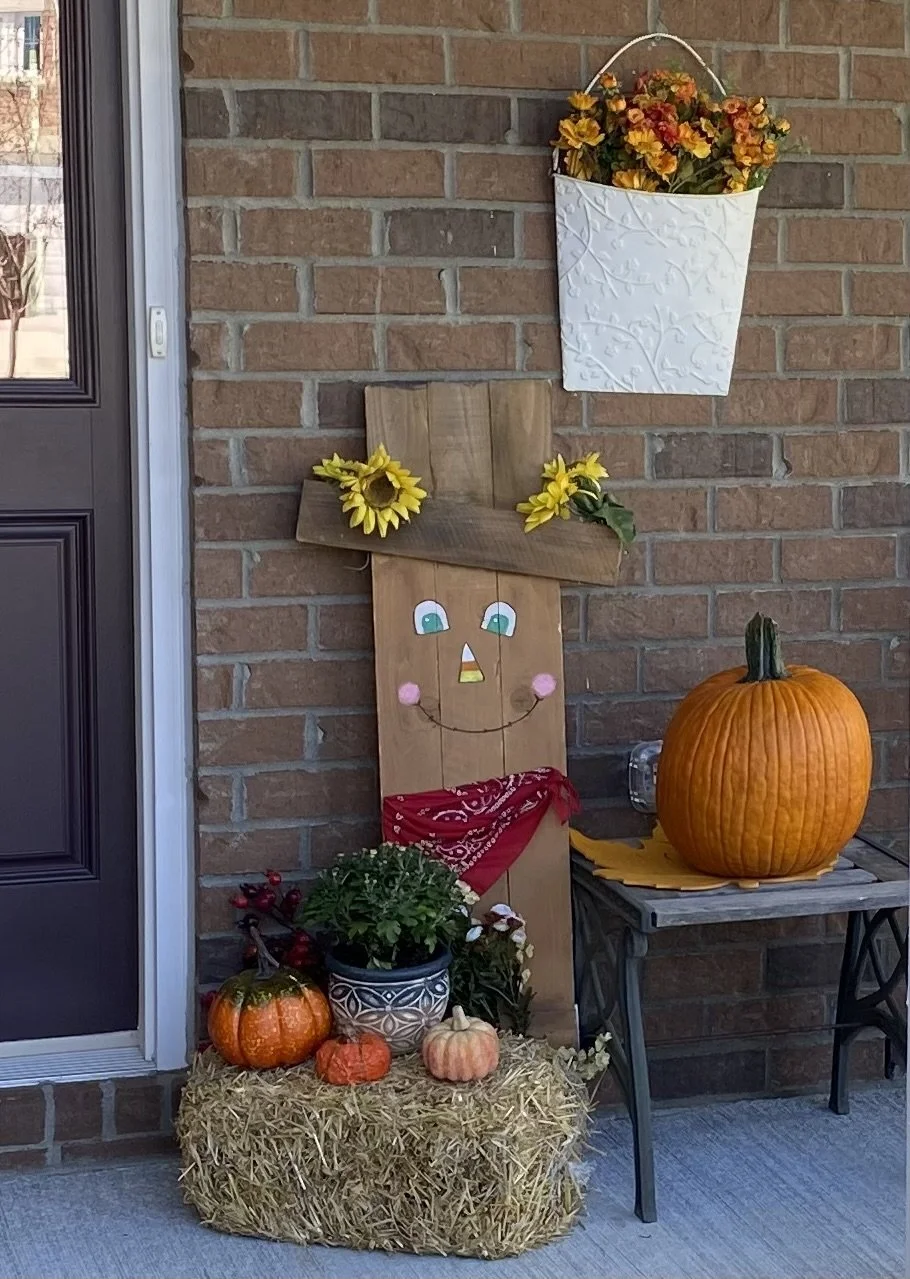
When a Trick is the Only Way
BLOG 2 October 15, 2025
October is here, the month for Tricks and Treats. Four years ago, my siblings and I needed to use a trick on our mom and let me say, it was no treat. Dementia caregiving is not child’s play. It’s serious business. And our need to “trick” our mom was a last resort decision, a decision that still tugs at my heart, and I want to share our story for anyone facing similar crossroads.
Understanding Dementia: The Unseen Challenges
Dementia is more than just memory loss. It gradually erodes a person’s ability to reason, make decisions, and even recognize their own limitations. People living with dementia often don’t realize they have a problem—a condition known as anosognosia. This lack of awareness makes conversations about safety nearly impossible. For families, it means that loved ones may adamantly resist help, believing they’re still capable of handling everything on their own. That was our mom in spades!
Family Challenges: The Long Road of Difficult Choices
We began our journey with gentle suggestions. After our father passed, Mom lived alone, and after a while we started encouraging her to downsize and consider a retirement community. She always said “No.” When her memory issues got serious enough, we organized a number of community tours, with and without her. Each time she was uninterested and annoyed by the suggestions. Were we pushing too hard, or not hard enough? The emotional toll of these conversations was heavy on all of us, and every visit with her ended with more worry than before.
Timeline ad Transitions: When Home Care Wasn’t Enough
We did everything we could to help Mom age in place, hoping she could stay in the home she loved for as long as possible. Eventually, it became clear that she was no longer safe living alone. We tried hiring a daytime health aide, thinking perhaps a little support would be enough. Unfortunately, dementia’s confusion made this impossible. Mom couldn’t remember why a stranger was in her house, leading her to call the police multiple times out of genuine fear. The idea of an around-the-clock aide was quickly ruled out—not just for the cost, but because it would have been even more distressing for her.
With none of us living nearby and every other option exhausted—including moving her in with one of us—we reached the point where professional memory care was the only safe solution.
The Move: A Difficult Plan with Love at its Core
Moving Mom was complicated by her devotion to her miniature Schnauzer, Carrie. We knew she would never agree to go anywhere without her dog. Luckily, after additional searching, I found a memory care community that welcomed both of them—a rare find. On moving day, my brother firmly told her we’d be visiting one more place. He told her that she could bring Carrie, and we’d have lunch together after the tour.
What we didn’t tell her was that the “tour” would become her new home. After lunch, we said we needed to visit the restrooms (a truthful lie)—and then didn’t come back for seven weeks. The staff, prepared and supportive, helped Mom settle in. I remember the ache of leaving her there without a proper goodbye, and the guilt that followed. Each day, the staff reassured her with a story we’d agreed upon—repeating it until, eventually, she stopped asking to go home. Only then did I return to Florida for a visit.
Aftermath and Emotion and Reflections: Living with the Decision
Was it right to trick her? The choice felt cruel but leaving her alone was unsafe and cruel in its own right. I know some will disagree with what we did. I understand their concerns. But when every option is terrible, sometimes all you can do is choose the least harmful path. We were as kind as possible in our treachery…treachery that was an act of love and meant for one purpose: to keep our mother safe.
If you’re reading this and struggling with similar decisions, please know you’re not alone. Feel free to reach out—I’m here to offer support, empathy, and understanding, because these choices are never easy, and nobody should have to face them alone.
Gratefully yours,
Donna
For My Mom on Her Birthday: Welcome to Elder Journey Insight
BLOG 1 October 1, 2025
Today would have been my mom’s 89th birthday, and I can’t think of a more meaningful way to honor her than by launching this new space: Elder Journey Insights.
This blog, along with my speaking platform and memoir which I hope to have published in the near future, is dedicated to one purpose—helping individuals and families prepare for and navigate the many twists and turns of elder care. My hope is that what I share here will give you the tools, perspective, and encouragement I wish I’d had when my family was suddenly thrust into decisions we weren’t ready to make.
Our Family’s Turning Point
Almost six years ago, we discovered just how serious my mom’s memory decline had become. Like many families, we weren’t prepared. It was overwhelming—emotionally and logistically. Four years ago, after countless conversations, decisions, and setbacks, Mom moved into a memory care community in South Florida, not far from the home she loved.
There were days when the journey felt impossibly heavy. But there were also moments of surprising beauty—unexpected laughter, kindness from friends and strangers, and the reassurance that we were doing the best we could for someone we loved so much.
Why I’m Writing
After Mom passed away 18 months ago, I felt both the emptiness of loss and the urgency to share what we had learned. Out of that came my memoir, now seeking publication. In writing it, I realized that our story is not unique—millions of families are walking similar paths. But while the details may differ, the core challenges remain the same:
How do you prepare for what’s coming when you don’t know what to expect?
How do you balance respect for your loved one’s independence with the realities of declining health?
How do you hold on to your own life while caring for someone else’s needs?
This blog is my way of offering real stories and practical advice, so you don’t have to feel as lost or as alone as we did.
What You Can Expect Here
Twice a month, I’ll share:
Practical advice on planning, caregiving, and navigating the elder care system
Personal stories that highlight the struggles and small victories of this journey
Encouragement and resources to help you prepare for what lies ahead
I’ll also provide updates on my speaking engagements, events, and the publication of my memoir. For those of you in the Cincinnati area, I’m currently offering free speaking sessions for community groups, churches, and organizations—because I believe these conversations are too important to put off.
A Birthday Memory
Since today is my mom’s birthday, I’ll close with one story.
When she turned 85, just weeks after moving into memory care, I made the hard choice not to visit in person. I worried my presence might unsettle her and cause her to beg to go home. Instead, I sent gifts, arranged visits from friends, and ordered a cake big enough to share with all three wings or neighborhoods as they called them in her new community. Later, I heard how much she smiled that day—surrounded by new friends, enjoying her cake, and presents with her little dog by her side.
It wasn’t the birthday I had imagined, but it turned out to be one of the happiest moments of that season. And it reminded me that even in the hardest transitions, joy can still find its way in.
Walking This Journey Together
If you’re facing decisions about aging parents, caregiving, or planning ahead for your own future, I invite you to join me here. Sign up for my Blog, follow along on Instagram or Facebook, or reach out directly. You don’t have to walk this journey alone.
For my mom, on her 89th.
And for all of us learning how to love, honor, and prepare for the elder years.
With gratitude,
Donna
For my mom on her birthday Oct 1
Welcome to Elder Journey Insights
October 1st would have been my mom’s 89th birthday, and I can’t think of a more meaningful way to honor her than by launching this new space: Elder Journey Insights. (Which I did by email on October 1st. Only now adding to my website as I continue to learn the technology.)
This blog, along with my speaking platform and memoir which I hope to have published in the near future, is dedicated to one purpose—helping individuals and families prepare for and navigate the many twists and turns of elder care. My hope is that what I share here will give you the tools, perspective, and encouragement I wish I’d had when my family was suddenly thrust into decisions we weren’t ready to make.
Our Family’s Turning Point
Almost six years ago, we discovered just how serious my mom’s memory decline had become. Like many families, we weren’t prepared. It was overwhelming—emotionally and logistically. Four years ago, after countless conversations, decisions, and setbacks, Mom moved into a memory care community in South Florida, not far from the home she loved.
There were days when the journey felt impossibly heavy. But there were also moments of surprising beauty—unexpected laughter, kindness from friends and strangers, and the reassurance that we were doing the best we could for someone we loved so much.
Why I’m Writing
After Mom passed away 18 months ago, I felt both the emptiness of loss and the urgency to share what we had learned. Out of that came my memoir, now seeking publication. In writing it, I realized that our story is not unique—millions of families are walking similar paths. But while the details may differ, the core challenges remain the same:
How do you prepare for what’s coming when you don’t know what to expect?
How do you balance respect for your loved one’s independence with the realities of declining health?
How do you hold on to your own life while caring for someone else’s needs?
This blog is my way of offering real stories and practical advice, so you don’t have to feel as lost or as alone as we did.
What You Can Expect Here
Twice a month, I’ll share:
Practical advice on planning, caregiving, and navigating the elder care system
Personal stories that highlight the struggles and small victories of this journey
Encouragement and resources to help you prepare for what lies ahead
I’ll also provide updates on my speaking engagements, events, and the publication of my memoir. For those of you in the Cincinnati area, I’m currently offering free speaking sessions for community groups, churches, and organizations—because I believe these conversations are too important to put off.
A Birthday Memory
Since today is my mom’s birthday, I’ll close with one story.
When she turned 85, just weeks after moving into memory care, I made the hard choice not to visit in person. I worried my presence might unsettle her and cause her to beg to go home. Instead, I sent gifts, arranged visits from friends, and ordered a cake big enough to share with all three wings or neighborhoods as they called them in her new community. Later, I heard how much she smiled that day—surrounded by new friends, enjoying her cake, and presents with her little dog by her side.
It wasn’t the birthday I had imagined, but it turned out to be one of the happiest moments of that season. And it reminded me that even in the hardest transitions, joy can still find its way in.
Walking This Journey Together
If you’re facing decisions about aging parents, caregiving, or planning ahead for your own future, I invite you to join me here. Sign up for my Blog, follow along on Instagram or Facebook, or reach out directly. You don’t have to walk this journey alone.
For my mom, on her 89th.
And for all of us learning how to love, honor, and prepare for the elder years.
With gratitude,
Donna
Welcome
When my mother began getting lost while out driving, my siblings and I didn’t know what to do. Our father was deceased and we all lived far away, hundreds and for some of us thousands of miles away. That was the beginning of a four and half year ordeal with many twists and turn. So many in fact, I began to ponder the idea of sharing what we had learned so others might have an easier journey when their loved ones start to decline. I decided first to write a book which I am still finalizing, and then I moved onto the idea of writing a blog and seeking speaking engagements to community groups as an elder care concerns advocate. I have created this website to promote all of these related endeavors including my work as a Certified Life Tribute Celebrant. I plan to post two blogs a month and welcome you to join my mailing list so I can let you know when I have posted something new. I am a member of the Ohio Chapter of the National Speakers Association and continue to develop my concepts and speaker’s platform.
My interest in things related to aging and elder care is a perfect complement to my freelance work as a Life Tribute Celebrant which I have been doing since September of 2018. I prepare and lead funerals and memorial services for families who don’t have a church home/pastor or any particular religious affiliation yet would like a beautifully prepared send off for their loved ones. I prepare religious and secular style services based on the needs of each family. Primarily, I work with Cincinnati’s Historic Spring Grove Cemetery and Funeral home but I have also worked with other funeralate the aging process. Please share what you have learned with others so they will also benefit from knowing more abou homes and private individuals who have learned about my services.
I hope over the coming months you will find my blogposts informative and useful as you and your loved ones navigt what to expect and what to do as time passages lead us each to face the elder years, either our own or the elder years of those we love.